|
|
|
2009
July
31
|
Econ-observation
I just realized what's been wrong with the economy.
Normally, people and businesses deplete savings
and get into debt during downturns,
then pay off the debt, and save, during periods of prosperity.
The past few years have been backward.
People got into debt during prosperous times and are in a hurry
to get out of it during the downturn!
(Because, of course, a lot of them got too close to the
limits of their ability to pay.)
Permanent link to this entry

|
2009
July
29-30
|
You can find anything on YouTube...
If I never get the spare time to fix up my vintage "Fujiya Corder"
(the tape recorder my father bought me in 1965, and which hasn't worked
since about 1972), I can at least
watch a video of someone else doing it.
You can also see a demonstration of a classic
Wollensak T-1500.
And there are lots more videos of vintage tape recorders.
Who would have thought that tape recorder restoration
would become such a popular hobby?
Permanent link to this entry
|
2009
July
28
|
Today's electronic ghost story
Sometimes a troubleshooting job has a touch of the weird
or uncanny. So it was with
my new TEAC tape deck on Sunday evening.
I played some of my old tapes and noticed that they sounded high-pitched.
Then I got out the calibration tape that I had thoughtfully purchased about
forty years ago, and measured the frequency with a digital oscilloscope.
Tape playback speed was about 15% high on both speeds, in both directions.
Strange.
There is no internal speed adjustment.
The tape deck uses a synchronous motor that can be set for either 50- or 60-Hz power.
But 50 instead of 60 should give a speed that is 20% high
(6/5 of normal). How did I get a 15% error?
It turns out the frequency setting is twofold. Not only do you move a belt from one
pulley to the next one, you also set a switch that affects (somehow) the way the motor
is energized. Both of these were wrong. After I corrected them, the speeds were correct.
And I'm glad I bought
a service manual!
Now I'm stuck with a recording I made the other day at 8.6 ips, which is not
a standard speed...
BTW, did you know that
Bing Crosby
brought tape recording to America?
He got hold of some captured German Magnetophons and had a small company
named Ampex reverse-engineer them.
Permanent link to this entry
|
2009
July
27
|
Good academic, bad human being?
Here
is an insightful and wise essay by Greg Mankiw
about the competitive world of professors and research scientists.
Permanent link to this entry
|
2009
July
26
(Extra)
|
Jupiter with satellite shadow and impact spot
Jupiter with satellite shadow:

Here are two good views of Jupiter from early this morning (July 26, about 2-3 a.m. EDT).
In the first one, the Great Red Spot is prominent, and also the shadow of the satellite Europa.
Europa itself is passing across Jupiter, very close to the center, but is
almost invisible because it's the same color as the planet. (It's not the dark spot;
Europa is slightly brighter than Jupiter.)
On the upper right edge of Jupiter is a dark notch whose true nature is revealed in the
second image.
The satellite Io is also in the picture.
Jupiter with impact spot:

Here Jupiter has rotated a little farther; the shadow of Europa is gone; Europa is probably
still on the face of Jupiter but I can't see it; and most importantly, the impact scar
(where a comet ran into Jupiter a few days ago) is plainly visible at the top.
Each of these was taken with an 8-inch telescope in my driveway, by recording about 2200 frames
of video and using RegiStax software to select and align the sharpest frames. In these
particular cases almost all of the frames were equally sharp, but the combination of them all
is sharper yet, and then RegiStax uses wavelet transforms to bring out detail.
Permanent link to this entry
|
2009
July
26
|
Bogus charges from Cellfish (Cellflirt)
Look at your cell-phone bill.
Ours, this month, was about $11 higher than usual. Examining it, we found
six spurious text messages and one spurious charge:
Cellflirt Text Chat MT Cellfish Media LLC 1-800-331-0500 $ 9.99
A quick Google search shows that this name often turns up in spurious charges.
AT&T is refunding for the text messages and asking the "merchant" to credit
the $9.99. If they don't, we'll protest the charge with AT&T.
But why do things like this persist long enough for a company to get a reputation?
If we had proper law enforcement in this country,
the proprietors of
Cellfish (the very name is fishy) would be out of business as soon as they were proven
guilty of one fraudulent charge. Another good idea would be a statutory liability
of, say, 100 times the amount of the fraudulent charge.
Also, years ago, when 900 numbers were new, I filed comments with the FCC that there should
be no such thing as a 900 number — that your telephone account should be used only by the telephone
company to charge you for telephone services. I still believe that. I recently spoke up
in favor of "using your cell phone as a bank" (popular in the Third World), but that implies
the physical presence of the telephone, not the dialing of a number.
And, more generally, in this wild and reckless era, we need more insistence on
verifying the identity and origin of any activity that incurs a charge.
That's one of several things that went wrong with the credit card industry.
Permanent link to this entry
And a new friend from the 1970s
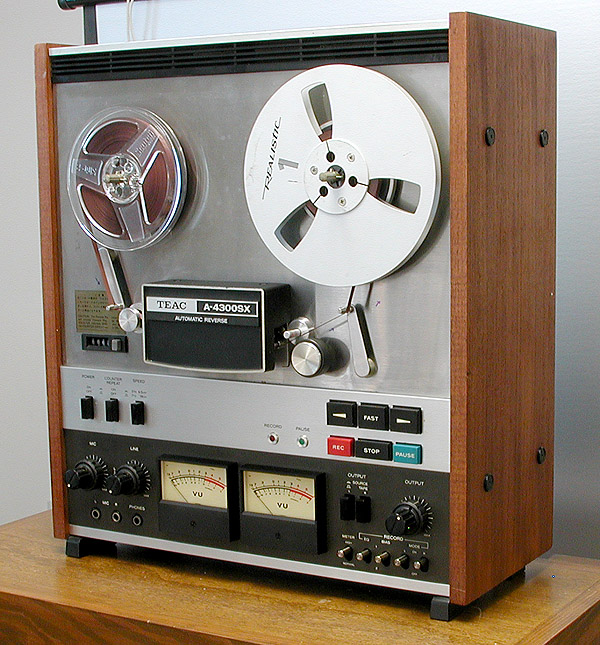
As I said the other day,
for more than 40 years solid, I've wanted to own a good 4-track stereo
reel-to-reel tape deck. And now I finally do.
This is the restored TEAC A-4300SX that I bought from
agkaudio on eBay.
He stands behind his products,
packs them as if they are going to be dropped from airplanes,
and is very helpful with questions before and after the sale.
Highly recommended.
Until now I've only had mono reel-to-reel equipment, currently a Wollensak 1500SS in need
of a minor overhaul. I still have the "Fujiya Corder" that my father gave me in 1965, plus
two more Fujiya Corders that I'm going to use for parts when I get around to restoring it;
it will definitely be a restoration job to fix a tape recorder that hasn't worked in more
than a third of a century.
Now what am I going to use the new deck for? Mainly for doing digital restorations of other people's
old reel-to-reel tapes. My own tape collection is rather limited, but it includes some irreplaceable
snippets of childhood (such as a recording of my sister's 6th birthday party) and also (thanks to my
father, an ATF agent) a collection of pre-recorded Treasury Department public service announcements
such as this one, definitely a taste of the Old South!
(Digitized using the Wollensak a few years ago;
the TEAC sounds better but I have not yet done any digitizations.)
I do plan to buy some music tapes. Although not quite as good as CD, reel-to-reel tape uses
8 times the surface area of tape, per second, as a cassette and sounds distinctly better.
Permanent link to this entry
|
2009
July
25
|
Happy anniversary, Melody! 27 years, and I want at least 2700 more!
An old friend from the 1970s
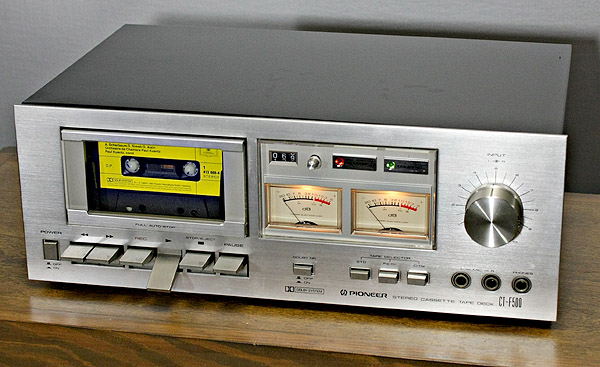
Although I've enjoyed reconnecting with people on Facebook, this is a different kind
of friend from the 1970s — my first good cassette deck. I bought it in 1977,
used it for ten years, gave it to Melody's father, got it back 20 years later when
he took down his old stereo system, and have just now installed a new belt kit
from wjoe.com. It sounds good!
Permanent link to this entry
|
2009
July
24
|
Econ-observations
The recession got to Georgia later than to most places, and was especially
late getting to the Athens area. We had quite low unemployment
until recently; now it's slightly higher than the national average.
I don't have any deep clues as to why, except that we are apparently farther
along the chain of causes and effects; we don't have as much industry as
other places, so we are suffering from the nationwide downturn, not any
specific early events.
The University is preparing to furlough faculty. No details yet.
I've pointed out numerous disadvantages of furloughs, but they do have one
advantage: they imply a commitment to return to the original pay level when
the crisis is over.
What is disappointing is that in the public discussion, there are people who
feel that a good university is a waste of good money, or that faculty members
don't have to work, simply because we don't have to sit in offices 40 hours
a week. I invite them to
read the job description.
See especially page 23, "Professor," "Criteria."
In what other profession do people have to become internationally famous
in order to be promoted?
Astronomers: The impact spot on Jupiter will be turned toward us around 1 a.m. EDT on the 24th (Friday morning).
Be there or be square! [Update: I was ready, but the sky was cloudy.]
Permanent link to this entry
|
2009
July
23
|
Better pictures of Jupiter
I've seen a flurry of excellent amateur photos of Jupiter with the impact spot.
One of the best is Dan
Llewellyn's.
See also everything on SpaceWeather.
I hope someone in Asia did HDR (high-dynamic-range) imaging of the solar eclipse;
haven't seen it yet.
Permanent link to this entry
|
2009
July
22
(Extra)
|
A miserable view of Jupiter with the impact spot
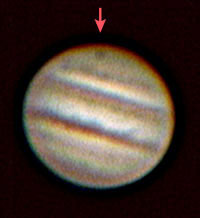
Conditions were terrible, with high clouds and turbulent air, but thanks to the power
of video astronomy, I got something. This was taken at 0413 UT on July 22.
The spot was genuinely bigger than in earlier pictures such as
this one. But mostly you are just looking at a blurry picture.
Other amateurs have done far better.
Permanent link to this entry
|
2009
July
22
|
Up in the sky...
As I write this, the solar eclipse has begun to sweep across Asia. CNN says "astronomers predict" it will
last six minutes (at any particular point), which is a bit of an understatement because there's no doubt how
long it will last — the calculations are quite exact. Here,
on the other side of the world, I'm getting ready to try to photograph the
spot on Jupiter, if the clouds will get out of the way.
Permanent link to this entry
|
2009
July
21
|
Short notes
Action on Jupiter:
Although I haven't photographed it myself (yet),
something has run into Jupiter,
apparently a comet, like the one that ran into it
exactly 15 years ago. I was startled to get e-mail about this today from a famous
astronomer — Heidi Hammel, of Space Telescope renown. Admittedly, it was e-mail to
several people at once... Anyhow, astronomers note: the spot transits the meridian about 2 hours later
than the Great Red Spot.
The Windows XP machine inside Windows 7 is described here.
It's an optional component; basically, what you get is a Windows XP license and the ability to
run it virtualized, with some handy interaction between the inner and outer filesystems. I have not tried this yet.
Tape deck found:
Thanks to a gentleman
out West who restores classic audio equipment,
I have a TEAC A-4300SX on the way, mechanically overhauled with new belts.
I've wanted something like this for 40 years...
|
A new service from Covington Innovations: Now that Melody is free-lancing, we've decided to add
audio restoration to the services we offer.
We can transfer your vinyl records, cassette tapes, or (very soon) reel-to-reel tapes to audio CDs
or MP3 files, and while we're at it, use signal processing to take out the pops, crackles, and hum,
improve the equalization, and clarify muffled speech. Over the years a few people have asked me to do
this professionally (and two have asked me to write books about how to do it!), but until now, I've
done it only as a hobby. Very preliminary announcement here;
more to come.
|
Is the world finally tired of video games?
Sales are way down.
A big setback for e-books:
The really alarming thing about
the Amazon Kindle's latest copyright mixup
is that Amazon didn't just stop selling the e-book — they yanked it right out of the Kindles on which it was
already installed! That level of network control is disconcerting. They should just sell the files and let me install them
wherever I want (without redistributing copies, of course). And if they find they've sold me one they didn't actually own,
the only honorable thing to do is let me keep it, and take the loss themselves
(by paying the rightful owner for it).
Incidents like this could kill the e-book and e-music industries quickly.
Permanent link to this entry
|
2009
July
20
|
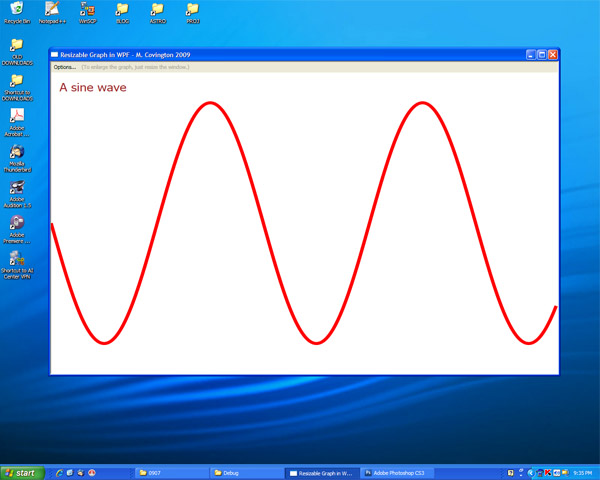
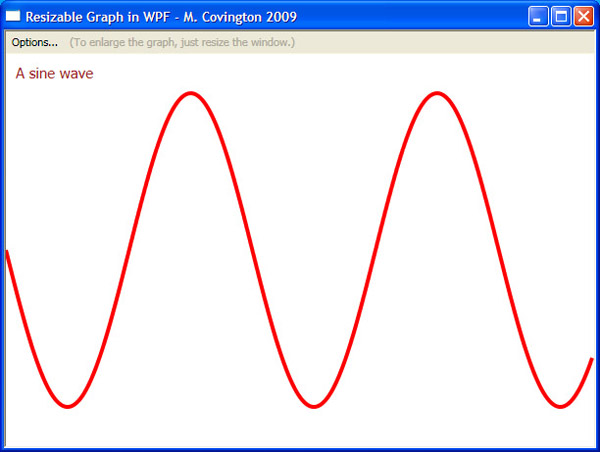
More WPF examples — Stretchable graphs
In preparation for some scientific work I'm going to be doing with WPF, I've hastily coded
a program that implements stretchable graphs. That is, you can plot a graph, and
the viewer can enlarge or shrink it by just resizing the window. There are also menu
options to revert to original size, export to JPEG, and export to the Clipboard (the latter
two are not affected by resizing the window). Here are a few pictures of what it does:
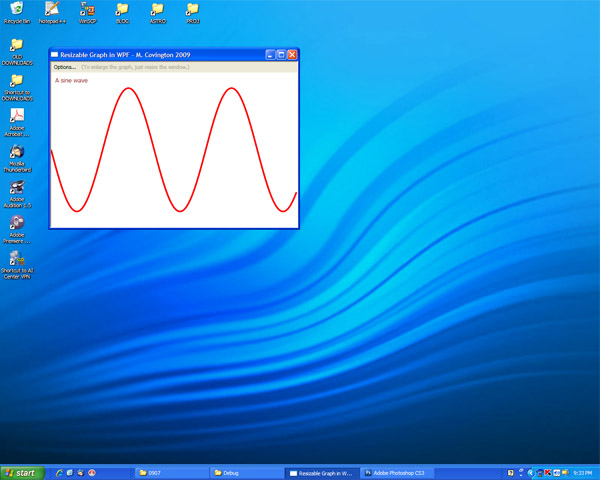
To download the source code, click here.
Permanent link to this entry
Short notes
Moon landing fake? Art Zorka of the Atlanta Astronomy Club points out that
the Soviet Union never said our moon landings were fake, and they would have had the
most to gain by discrediting them, as well as the technical means to check them out
fairly thoroughly.
Infinite music library: Did I mention how much I'm enjoying the
self-customizing Internet radio broadcaster www.last.fm?
Just type in the name of any performer or song, and you'll get a program of that kind of music.
You can have an all-Bert Kaempfert channel if you want. Nobody is too obscure.
If you haven't heard of Gigliola Ginquetti, now's your chance.
German "Schlager-Musik" (comprising "hit" vocalists) is particularly well represented;
sample it here, but all too soon,
the songs all sound alike. They have plenty of classical music, too.
More local wildlife: This box turtle was crossing the street the other day,
trying to get to the high ground behind my house, so I helped him, and he posed for
an informal portrait.

Permanent link to this entry
|
2009
July
19
|
The right way to save a WPF Canvas to a JPEG file
or to the Clipboard
I've been exploring WPF, the new graphics subsystem of Windows.
It's a different world. Some key concepts:
- Everything is vector graphics, not pixels.
- You draw, not by altering pixels, but by adding things to the list
of things to be drawn. WPF renders them whenever appropriate as you
move, resize, hide, and expose the window.
- Coordinates are in units of 1/96 inch (nominal), just like pixels
except that they're floating-point. You can put something at point
(24.356, 119.230) if you want.
- You draw on a panel. The surface of a window is a panel;
but the simplest kind of panel is called a canvas and is
what we normally use for graphics. Other kinds of panels are called
grids and have the ability to arrange their contents automatically.
- Normally a panel sits in the client area of a window and has definite
margins. When you resize the window, you resize the panel, and you can reveal
parts of the drawing that were originally outside its bounds. But if you
put the panel in a container called a Viewbox, it will stretch
rather than just resizing.
I've constructed a
sample C# project that you
can download to see how to do some simple drawing and how to save
the results to a JPEG file or export them to the clipboard.
Here's what it looks like, running:
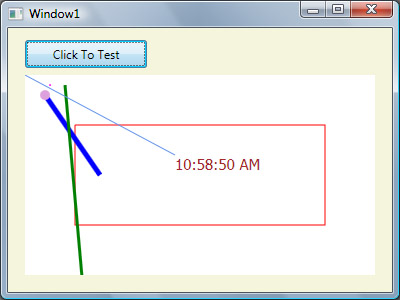
(The lines, dots, and text are just arbitrary samples of how to draw things.)
Here's the exported JPEG (sized to fit this page):
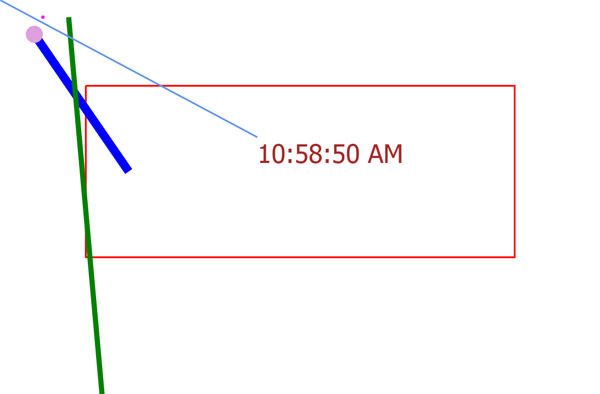
Note that the JPEG has more resolution than the on-screen image.
That comes from using vector graphics — this is not a copy of a
block of pixels; it's a separate rendition of the same drawing.
Let's consider saving to JPEG. There are many examples of this on the
Internet that are almost right. After considerable experimentation,
I got the bugs out, and here's the result:
static void SaveAsJpeg(Panel c, double dpi, string filename)
{
using (FileStream fs = new FileStream(filename, System.IO.FileMode.Create))
{
var enc = new JpegBitmapEncoder();
enc.QualityLevel = 90; // JPEG quality
enc.Frames.Add(BitmapFrame.Create(MakeBitmap(c, dpi)));
enc.Save(fs);
}
}
static RenderTargetBitmap MakeBitmap(Panel c, double dpi)
{
// Deprive the panel temporarily of its positioning and margins
Transform tsave = c.LayoutTransform;
c.LayoutTransform = null;
Thickness msave = c.Margin;
c.Margin = new Thickness(0, 0,
msave.Right - msave.Left, msave.Bottom - msave.Top);
// Prepare to render the panel in a rectangle the same size as itself
Size size = new Size(c.ActualWidth, c.ActualHeight);
c.Measure(size);
c.Arrange(new Rect(size));
// Render to a bitmap. Note that pixel count is adjusted for dpi.
var b =
new RenderTargetBitmap(
(int)(size.Width * dpi / 96),
(int)(size.Height * dpi / 96),
dpi,
dpi,
PixelFormats.Default
);
b.Render(c);
// Restore the positioning and margins of the canvas
c.LayoutTransform = tsave;
c.Margin = msave;
return b;
}
The first of these two methods is easy: get an encoder and use it to write a bitmap
onto a JPEG file. But how do you get a bitmap?
That's the second method, which makes a RenderBitmap object from the canvas or other panel.
Remember that a panel is really a list of things to draw and where to draw them.
The MakeBitmap method renders it as a bitmap at any dpi you choose, not just 96.
That's how you create a JPEG that is much sharper than the screen.
Many versions of this method are circulating on the Internet with various flaws in
them. What's crucial is that you have to deprive the panel or canvas of its margins
and transformations, and render it in a plain rectangle of known size, and then
put the margins and transformations back so that it can continue rendering
properly on the screen. You have to use
ActualWidth and ActualHeight because an auto-sized canvas (a common kind) has no Width
or Height of its own.
In my opinion MakeBitmap should be part of the system library. It's frequently needed
and, as a web search will quickly show, hard to get entirely correct.
I can't be sure that I have everything exactly right even now.
You can also put a WPF panel into a bitmap on the Clipboard,
ready to be pasted into Word, Photoshop, or the like:
static void CopyCanvasToClipboard(Panel c, double dpi)
{
var d = new System.Windows.DataObject();
d.SetData(
System.Windows.DataFormats.Bitmap,
MakeBitmap(c,dpi),
true
);
System.Windows.Clipboard.SetDataObject(d, true);
}
This is separate from, and more complicated than, simply putting a WPF graphic
onto the Clipboard as itself, ready to be pasted into another WPF application.
Permanent link to this entry
|
2009
July
18
|
Was the Apollo 11 moon landing a fake?
Logic and preconceptions
The 40th anniversary of the landing of Apollo 11 is coming up,
and something like 20% of the public seems to believe, for no
clear reason, that the whole thing was faked.
And here we bump into a fundamental problem of logic that
nobody talks about: prior probabilities.
In the real world, you seldom have absolute proof or disproof
of anything; you have to weigh evidence and judge probabilities.
The trouble is, your judgment of new evidence has to be based on what you
thought the probability was, before you got the new evidence.
And there's the rub. If your prior estimate of the probability
is extremely low or extremely high, evidence won't change it much.
If you start out sure people could never have walked on the moon,
you'll believe anything else, no matter how far-fetched. Conversely,
if you're the kind of person who believes our government could never
fake anything (ha!), you're immune to evidence in the other direction.
I've mentioned this briefly before (see
this
and
this).
A couple of centuries ago, educated people were sure meteorites
couldn't be real, so they accepted any alternative explanation instead.
And they were wrong.
Why do some people disbelieve the moon landing?
Several reasons, including distrust of government (which can be healthy),
but I think one of the biggest is
failure to appreciate the moon as a physical object of a certain
size, shape, and distance. If, deep down, you think the moon is a
sort of illuminated dinner-plate hanging a few hundred feet above the
earth, you won't believe people could walk on it.
Ditto if you think the moon and sky are so small and so low that anything going
to the moon would have disrupted the ordinary appearance of the sky.
It is a fact that the Apollo 11 lander was not seen in earth-based telescopes, and some
people don't understand why.
If, like many 1960s TV watchers, you have suddenly become aware that
anything you see on TV can be fake, you'll figure this must be just
another one.
And, above all, if you don't want to be bothered with all this
new science that you didn't absorb in school, you can take refuge
in believing that there isn't really anything to it.
Permanent link to this entry
The saga of Minerva
I need to recount a recent series of unfortunate events in a more orderly way.
My 2.4-GHz single-core desktop machine, Minerva, was set up to triple-boot Windows
XP, Vista, and Windows 7. Most of the work was done under XP, which was full of
"gunk" (files and registry settings left over from the software of several years ago).
It was slow and needed cleaning up.
I thought installing Vista over XP would clean it up. It didn't.
I then did a clean install of Vista and found that my soundcard and my audio software
didn't work properly. This is actually due to an improvement in Vista — which
now treats audio inputs as separate devices, so you can mix and match if you have more
than one soundcard — but I'm too cheap to upgrade Adobe Audition right now.
Also, Vista was just a bit sluggish.
So I wiped out Vista and installed XP. Success — the computer, including
legacy hardware and software, is fully functional, fast, and responsive.
Next I need to restore the dual-boot capability, probably by reinstalling Windows 7.
The moral? Older computers should have older operating systems; too much older hardware
is not well supported by Vista, which insists on a newer, more secure type of drivers.
Permanent link to this entry
|
2009
July
17
|
Back to Windows XP
It was a case of
new wine in old wineskins
(not literally).
I've reformatted drive C of Minerva again and
this time have put Windows XP back on it.
The reason is that Vista doesn't fully support old hardware,
nor old software that depends closely on the hardware interface.
Vista has rearranged the audio system, and Audition 1.5 couldn't
find any recording devices. Also, experts tell me a single-core
computer with 2 GB RAM is a bit small or slow for Vista, and they
may be right.
Permanent link to this entry
|
2009
July
16
|
Annoyance: No fully functional Vista driver
for Creative Labs Sound Blaster PCI 128
[Updated.]
When I upgraded my desktop computer to Vista,
I thought Vista's driver for the Creative Labs soundcard was OK
because I had no trouble playing audio.
Tonight I tried to record, and lots of things were wrong.
The recording devices can't be selected or have their levels set.
The root of the problem is that the Sound Blaster PCI 128
is really an Ensoniq ES1370
and the nearest that Microsoft can come is a driver for
the ES1371. Creative Labs bought Ensoniq and then quickly
lost interest in the product line.
Also, in Vista, audio recording has apparently been reorganized.
Instead of multiple inputs on each device, the system sees multiple devices.
I haven't entirely figured out the controls.
But I think part of the problem is the driver.
Permanent link to this entry
|
2009
July
15
(Extra)
|
Computer security conundrums
#1: Hotmail won't let me send e-mail about the stock market to a friend
whom I wanted to ask a couple of things — it thinks I'm a spammer. Weird.
[Update:] E-mail to and from covingtoninnovations.com is inoperative at the
moment; before that, it was apparently misconfigured, causing some spam filters to
block the mail. Incoming messages since late last night (Tuesday) may have been lost.
[Update, July 15, 8 p.m.:] The people at Hotmail tell me that someone either using
or impersonating Sectorlink's server has been spamming them. This is being
investigated, but in the meantime, I'm penalized just for using the same server.
The hidden cost of spam is the amount of legitimate mail
that doesn't go through.
A few years ago, mail from covingtoninnovations.com had a lot more prestige than
mail from Gmail or Hotmail, but now the tide has turned. Large e-mail services that
cater to newbies seem to be more trusted than smaller ones, because it's easier
to keep track of them, and virtually impossible to send spam through them.
Or to put it another way: Nowadays your e-mail address is supposed to say who handles
your mail, not where you actually are.
#2: Windows woke up incompatible with Kaspersky Antivirus this morning.
The latest Windows Update causes the Windows security system to report that
the firewall and antivirus protection provided by Kaspersky are no longer compatible.
Here's the most informative part of the warning:
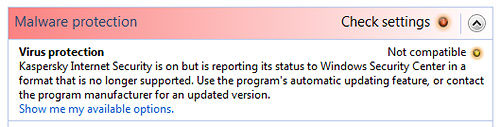
Kaspersky is up to date and is the 2009 edition. I'll post more news as it transpires.
For now, I'm assuming Kaspersky is still working, whether or not Windows recognizes it.
[Update:] Kaspersky offers
free upgrades to the latest version for all currently licensed customers, but it requires a
whole uninstall-reinstall procedure. I do not yet know whether they actually have a solution for
Microsoft's latest problem, and I hope they'll be able to fix it with an automatic update.
So I'm holding off on making a change.
Meanwhile, why did Microsoft pull this dirty trick on them?
[Further update:] The afflicted computer was about to install Service Pack 2, which fixed the problem;
no need to download anything from Kaspersky.
Permanent link to this entry
|
2009
July
15
|
"Fell" is an odd way to say "rose"
"Compared with the same period last year ... producer prices fell 4.6 percent,"
says Reuters.
The fact is, this month the Producer Price Index rose sharply.
It did not fall. It is true to say that it is
still lower than a year ago, but not that it fell this month
(relative to anything).
See my earlier remarks
on the confusing way inflation is reported in the media.
It gets worse. I can remember many times hearing newscasters say "inflation rose"
when they meant "prices rose." Inflation is the rate of change of prices,
and it is possible for prices to rise and inflation to fall at the same time, if
prices are going up but the rate of increase is diminishing.
Maybe everybody needs a semester of calculus, to get a firm grip on the difference
between a quantity and a rate of change...
Permanent link to this entry
Vista or Windows 7?
Skip Vista, not Windows 7: People are now telling each other
to skip Windows 7.
Why? It's better than Vista.
Skip Vista if you want to omit a Windows version; that's what part
of my lab is going to do. We'll bring everybody up to Windows 7 in
about a year.
More to the point, it sounds like Windows 7 is being disparaged by rumor and
unfounded innuendo, the way Vista was. I frequently run into people who
"have heard" that Vista is just terrible. I find it better than Windows XP,
and Windows 7 is better yet. What is supposed to be wrong with them?
Permanent link to this entry
|
2009
July
14
|
Short notes
For an audio restoration project, I may soon be needing a 4-track stereo
reel-to-reel tape deck in good condition. Because reel-to-reel tape equipment is
heavy and expensive to ship, it's advantageous to buy locally.
If you know of one of these that is looking
for a new home near me, please let me know.
I disliked Windows Presentation Foundation (WPF) (the new Windows GUI)
until I was halfway through writing my first substantial program with it.
Now I like it.
The GUI components just behave more reasonably (by default) than in WinForms.
Some handy things are missing — for example, common file dialogs can't be
placed on the form, they have to be created in C# — but future releases will
surely fix these minor inconveniences.
How I did magic: A friend sent me an XD memory card that was unreadable
(corrupted in the camera). I thought I had file recovery software on hand, but I didn't.
On a hunch, I ran CHKDSK on it. I got about 5,000 files, of which 214 (the largest) were valid JPEGs.
These may well be all the pictures! The rest were chunks of empty space on the card.
Of course, I had to rename FILE*.CHK to FILE*.JPG.
Permanent link to this entry
|
2009
July
13
|
Is it July Fool's Day?
New superstitions about credit cards?
I think this may have been a joke that wasn't recognized as such by the reporters
who are passing it along.
Credit-card companies will supposedly yank your credit if you buy lottery tickets,
trips to the spa, drinks with a buddy, or
(get this) have your tires retreaded.
American Public Media story here;
their sequel here;
and the Atlanta newspaper's follow-up here.
[Update:] Not a joke, but a somewhat speculative allegation. There are shreds of
evidence that such things may have been tried. That's no reason to spread the
notion that these practices are established and widespread. American Public Radio apparently did
not question the allegations, or talk to anyone who might question them, before publishing them. Read on...
Now, we know of the allegations of
redlining by American Express
(which is a company with a reputation for peculiarities).
And we also know that this country has anti-redlining laws, so I thought that
particular episode had blown over.
Anyway, how is a credit-card company going to know whether you're buying lottery tickets (vs. snacks or gasoline)
or whether you're having your tires retreaded (vs. buying new ones or getting other work done)?
As far as I can determine, they don't receive a line-by-line copy
of your invoice — only the total amount and where you spent it.
I smell a new urban superstition here. People don't want to admit they're getting their credit
yanked for not paying their bills on time, so they want to believe it was because they went to the spa
or bought the wrong
kind of tires. Since the whole thing is supposedly secret, once a person jumps to such a conclusion, they're
not going to let go of it.
By "urban superstition" I mean an unwarranted belief passed by word of mouth among educated people,
such as the long-standing notion that you can delay the clearing of a check by writing it
in red ink, or repel dogs by putting out jugs of water.
And does anyone recall that the credit-card companies actually want to stay in business despite
their difficulties? They're not going to drive off good customers for arbitrary reasons. At least, so I
tend to presume. Our banking industry has done some foolish things. But before I believe this one,
I want definite evidence.
Permanent link to this entry
|
2009
July
12
|
Local wildlife...

Although not as handsome as the
green anoles
that I commonly photograph
(see also this
and this),
this fat skink was perched outside a window to greet me the other day.
For at least 20 years, we've had skinks around the outside of the house,
but they are secretive, and whole years go by without my seeing any of them.
I hope they are eating plenty of spiders and ants,
and that they aren't bothering the green anoles.
Permanent link to this entry
Furloughs?
Like the rest of the University of Georgia faculty, I've just signed my employment
contract for 2009-10, and for the first time, this contract
gives the University the right to furlough us for up to 10 days
if they choose to, to save money.
I've already
pointed
out some problems with trying to do that, and now
law
professor David Trubek (up in Wisconsin) opens another can of worms:
Furloughs collide with the Fair Labor Standards Act in a bothersome way.
Normally, like most professionals and managers,
faculty members are "exempt" employees (exempt from the hourly minimum wage and
some related requirements). "Exempt" employees are hired by the week or month, not paid
by the hour.
That means you can't furlough an "exempt" employee (or if you do, you still
have to pay him).
What you can do, of course — and what the U. of Wisconsin did — is convert
them all, on paper, to hourly employees. They don't actually keep track of the hours worked,
but now they can declare that an employee isn't assigned to work the full 40 hours in some particular week.
And then faculty members have to be forbidden to work while on furlough —
they can't do any University-related work, even voluntarily, or their university would be in hot
water for not paying hourly employees for hours worked!
I want to see Georgia's legal minds tackle this. Not everyone understands the labor laws the same way
the Wisconsin people do.
[Update:] Actually reading the Act, I see that it explicitly designates teachers as "exempt" and I don't
see how an employer can change that.
Nor do I see it setting any specifications for how to employ exempt workers (that's the point of exempting them).
It looks like Wisconsin got into a mess of its own making.
What I object to is not so much the prospect of a pay cut, as the dishonesty —
the weird gyrations to call it something other than
a pay cut. Wisconsin faculty members are apparently being expected to sign statements
falsely saying that they didn't work on particular days.
And of course faculty members compete on research productivity, so
there will not be any reduction in the total amount of work expected!
Permanent link to this entry
|
2009
July
11
|
What the moon looked like in 1971
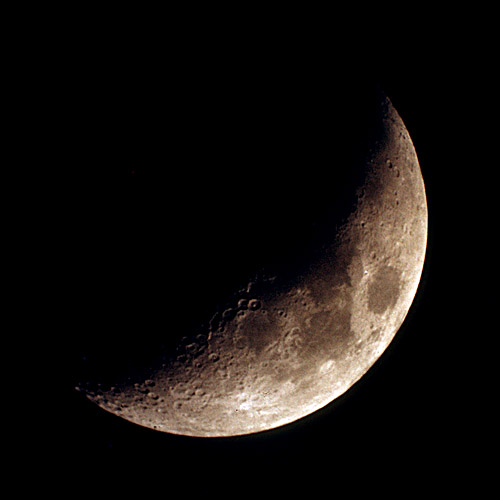
Here is one of my early astrophotographic triumphs. It was taken in early 1971
with a Voigtländer Vito B camera aimed into the eyepiece of a 6-inch f/8
reflecting telescope, on Kodachrome-X, if memory serves me right.
(The notebook describing it is inaccessible at the moment, but I still
have it.) Not too bad for a 13-year-old, if I may say so.
Permanent link to this entry
|
2009
July
10
|
Short notes
Recommended: TheSkyX astronomy software.
But make good and sure you have OpenGL graphics drivers. If you don't, the program will run, but
all sorts of things will be missing from the display.
Recommended: WinSCP FTP client software (which also does SFTP).
You can download either a ready-to-run .exe (to carry on your thumb drive, so you can FTP from cybercafés
in Hanoi) or an installation package. I recommend the latter, and choose "Explorer-like interface" (not the default).
Mixed feelings about: Constant software updates. I'm glad Nero gave me an update, free, just because I switched
to Vista, but it was 300 megabytes. I'm not so happy that Adobe keeps giving me time-consuming updates when I haven't
changed anything. Either they're fidgety, or they're making lots of mistakes that they have to hurry
to correct.
Answered: Why security updates are so often needed for
software that has nothing to do with the OS or networking.
A correspondent points out that people are still programming the way they did in 1985: A graphics
or multimedia file
consists of various blocks of data, each of which begins with a number saying how long it is.
Programs read these by reading the number, then reading that many bytes whether or not there is room for them.
(Can't spare the time to check; it might waste a whole microsecond!)
A malicious program can exploit this to put its own data (i.e., instructions) right on top of the running
program in memory (spilling over the area where the data is supposed to go).
Come on, software engineers,
we've known about this for a quarter century. There are numerous ways to prevent it. I'm tired of needing
security patches for graphics viewers!
Permanent link to this entry
|
2009
July
9
|
Two cyber-observations
Will this
week's DDoS attack on the U.S. Government be the stimulus that finally prods us to
re-engineer the Internet to make it secure? The trouble with the present Internet is that all the computers
are programmed to believe whatever they're told about where a message originated.
That was fine when the Internet was just for a few laboratories — back in 1975 or so.
Linux may be about to fall upon good times if Google's
Chrome OS takes off. That's Linux with a new GUI.
Unlike earlier Linux advocates,
Google, Inc., actually has the ability, I think, to promote it,
support it, and convince people that they can use it.
What I want, of course, is a programming environment as good as Visual Studio with C#;
that's what Linux seems to be lacking, and its advocates
don't seem to know what they're missing.
Permanent link to this entry
|
2009
July
8
|
Short notes
California goes weird on us:
Due to a failed political system ("direct democracy" or "we have to please everybody"),
California is now paying its bills,
not with regular warrants (checks drawn on the state treasury),
but with "registered warrants," which are no good until October, and possibly
not even then.
State government FAQ here.
And now major
banks aren't wanting to take these things.
Meanwhile, Mankiw argues that
Medicare
should spend more money — on cost and fraud control, that is —
even though it would raise their extraordinarily low "administrative costs."
Keeping administrative costs too low does not keep total costs low.
Much closer to home,
here is
how to pre-order Windows 7.
See also the material I added to the last part of yesterday's entry, below.
Permanent link to this entry
|
2009
July
7
|
Minerva's makeover
My 2.4-GHz Pentium system, Minerva, is getting a complete makeover.
I cleared off one of the disk drives and set it up to be the boot disk.
Then I installed Windows Vista Ultimate on it.
The process looked like something out of the Three Stooges because the
Vista license was an upgrade, so Setup wouldn't launch until I first
put Windows XP on the hard disk. But the XP license was also an upgrade,
and to launch it, I had to show it (fortunately not install, but just let it look at)
an old Windows 95 installation disk (actually not the one with which my license chain
actually began, but it worked).
Vista runs much faster when not burdened by the fragments of software from yesteryear!
Permanent link to this entry
"Updates" as an intrusive advertising tactic
"You can't use your computer today; Big Brother wants to work on it." That seems
to be the motto of Adobe Systems, and also of Nokia PC Suite (the software for communicating
with cell phones). For unknown reasons the Nokia software has wanted to update itself
twice in the past few days.
I think I know what's going on. These "updates" are to get our attention for advertising
purposes. Adobe and Nokia want to keep their names in front of my face.
In short, updates are a form of pop-up advertising, perhaps
intended to appeal to people with short attention spans,
the kind who read Twitter and get nervous if nobody "tweets" for two solid minutes.
The alternative is that the software is incompetently built and the programmers are
scrambling to make corrections
every few days. I wonder if any
of the manufacturers realize this is the message they may be sending.
The other day someone asked me how often we update TIP,
a software product that I helped build.
The answer? "We haven't had an update for more than a year... We built it the way we wanted it,
and there's not much to change." Am I the only programmer in the world who thinks that way?
Is that why I'm not rich?
[Update:]
A correspondent points out that these are "security updates" to patch holes that compromise
system security.
Which leads me to ask: Why do application programs have security holes in them in the first place?
They are things like PDF viewers or cell-phone utilities.
They don't accept contacts from outside — do they?
Are manufacturers building in secret "back doors" to our systems,
or are they just inept?
Permanent link to this entry
|
2009
July
5-6
|
An excellent one-day vacation


Melody and I had an excellent one-day vacation on the Fourth.
An old friend from near Valdosta invited us up to Lake Burton
to watch the fireworks. The lake and its
surroundings may be the finest scenery in Georgia, and the
fireworks show was certainly the most copious we've ever seen,
with blasts every few seconds for half an hour solid.
That's why I wasn't here, writing the Daily Notebook!
Permanent link to this entry
A Windows grumble
Installing Linux takes 30 minutes; installing Windows Vista can take the better part of two days
as you go through Service Pack 1 and 2 and Vista spends hours talking to Big Brother on the Internet
(pardon me, I mean "downloading updates"). I've done both of these things this (long) weekend.
And it's not over. Installing Vista over a somewhat bloated and gunky Windows XP installation does
not clean it up. So now I'm moving all my data onto a different disk drive and preparing to swap
disks and do a clean install, then reinstall my software, item by item.
Permanent link to this entry
|
2009
July
4
|
Computers, computers, computers...
I spent the Third of July working on my computers.
Although I've installed Vista many times before, installing it over XP was something I'd never done before,
and it took about eight hours!
[Note added Dec. 19: I now know that the computer had a slowly failing disk drive,
and apparently the Vista installation used some of the defective space while the XP installation did not.
All kinds of disk operations became abnormally slow as the drive deteriorated.]
I also checked out some older computers and was glad to find that my IBM PS/2 Model 70, vintage 1990,
still runs. It is the most expensive PC I've ever bought ($5500, bought with IBM prize money, which is
why I didn't buy a clone; also, in those days we had doubts about the reliability of clones).
That $5500 is maybe $8000 in today's dollars,
but I made it all back quickly, writing magazine articles.
My very first IBM PC, in 1984, cost $3000,
which is $6000 in today's dollars, and I joked about getting a bumper sticker printed: "My other car
is an IBM PC." In fact, most of my cars, over the years,
have cost only slightly more than my computers; some have
cost less.
Nowadays you can't spend $6000 on a PC if you want to. (Well, maybe an 8-core Macintosh with an enormous screen;
but even then, I'm not sure.) I'm typing on a $500 laptop (dual-core, Vista Home Premium) and contemplating
an $800 desktop (quad-core).
Back to the PS/2: I'm delighted to find that it has a
cult following
(see also here)
and I can even put it on the Ethernet.
(It is, after all, the Edsel
of the computer world, sophisticated but not what the market wanted at the time.)
Now where can I find an 8-bit (not 16-bit) ISA-bus 10base-T network card for the
original IBM PC, which is still displayed proudly in the living room?
Permanent link to this entry
Recycle me? Where?
Contrary to what it says on the bag,
you can't recycle Target shopping bags at a Target store,
at least in Athens, Georgia.
Nor much of anywhere else.
They are type 4 plastic, and our local recyclery only takes types 1 and 2.
Happy Fourth of July, everyone!
Permanent link to this entry
|
2009
July
3
|
Downtown?

This looks like the old downtown area of any Georgia (or eastern U.S.) town,
built in the 1880s to 1920s.
But it's actually a row of storefronts in Watkinsville, Georgia, built less
than a year ago; most of them have not yet been occupied.
Melody pointed out one sure sign of non-authenticity: They're all built
with the same kind of brick.
(Cell phone photo, Nokia 6085.)
Permanent link to this entry
Highly recommended book

I highly recommend Steven Bird et al.'s new book about the
Natural Language Toolkit (NLTK).
In fact, I plan to use it as a textbook, even though it competes
with one I wrote myself
(for a somewhat different target audience) a few years ago.
As NLP textbooks go, this one has two special features:
(1) it is based on Python and the NLTK, and does not presume any programming experience;
(2) it uses the most modern tools, including taggers, Bayesian classifiers, and parsers,
and includes them, ready-to-use, in the free software package.
Python is a programming language that is designed to be powerful but easy to learn.
The NLTK is a collection of data and software components for processing human language.
In teaching NLP, I face two challenges. The computer science students are impatient with the
details of English; they wish the language could be redesigned to suit their software, or they
write software that just ignores what looks messy (e.g., ignoring sentence structure and losing
the distinction between "dog bites man" and "man bites dog"). The linguists don't want to
do much programming; what they really want is application software.
This book caters slightly more to linguists than to computer scientists, although I think
I can use it with a mixed class of both. (I'll add some linguistics material for the CS people.)
The book is slightly weak on algorithms, but, realistically, it contains as much content as a person
can take in
during a single semester, and unlike other "information retrieval" books, it doesn't
shy away from parsing and semantics. Students can proceed to more advanced books later.
What is important is that until now there hasn't been an accessible, introductory book
focusing on the most modern tools. This book will familiarize beginners with
current practices.
Permanent link to this entry
|
2009
July
2
(Extra)
|
Still want a monitor that isn't widescreen?
If you still want a computer monitor with the conventional (4:3) width-to-height ratio
instead of the new "widescreen" type,
you
can still buy them from Dell,
and I just ordered a pair of 19-inchers.
I use a video card that drives two monitors. That is apparently what power users did about three years ago,
before everybody went widescreen.
The fact is, two conventional 19-inch monitors give you more screen space than a widescreen 24-inch,
and besides, you can maximize a window in either of them while leaving the other one free.
Apparently, in the widescreen world, people no longer maximize windows.
[Addendum:]
Wider is not bigger.
An old-style 19-inch monitor is 1280×1024 pixels.
A widescreen 19-inch is 1440×900 pixels.
It's wider but not as high, and the total screen area is
slightly less. To get a screen that is 1024 pixels high (or nominally 1080),
you need (I think) a 24-inch widescreen monitor.
Permanent link to this entry
|
2009
July
2
|
Mystery calls from
Healthcare Fiscal Management, 800-425-0435
[Updated.] This entry is written mainly for people who
are looking for 800-425-0435 using a search engine.
Here's the scoop...
We have been receiving recorded telephone messages
(from Caller ID 800-425-0435)
telling us to call the financial department of a local hospital.
Sharon and I have both had minor procedures done at that hospital recently
(the earliest on June 5) and, prior to that, had had
no dealings with them for many years.
On calling the financial department, on one occasion they couldn't
tell us what it was about, and on another, they didn't even answer.
Googling the number, I find that it belongs to
Healthcare Fiscal Management, Inc. (HFMI)
and there are
multiple
allegations of nuisance calls from this number,
some of them violating the Fair Debt Collection Practices Act.
What are they calling me about? Surely not about my bill?
I have not received a bill from this hospital yet
(and it's not time to; the activity started less than a month ago;
I've received some insurance paperwork but not a final bill).
Maybe they're peddling a time-payment scheme.
All I know is,
it's rude (as well as useless)
to ring my telephone repeatedly and not have a human being
on the line or a definite message for me.
And it's completely wacky to start trying to collect a bill by telephone
before the paper bill has even been sent out.
I called an executive at the hospital and brought all this to their attention.
They are sending HFMI a stiff warning and may stop using their services.
They are going to send me the bills on paper, and then,
if everything is in order, I'll pay them.
Personally, I would like to see a complete ban on machine-originated
phone calls to humans, regardless of the business relationship.
Autodialers make it too easy to be discourteous to thousands of people at a time.
Permanent link to this entry
|
2009
July
1
|
Gleanings from the financial news
Melody's graphic design business
is off to a good (re)start, but (as you might
guess) after one day there's still room for more clients, so let us know if you
need anything.
Contrary to the whining we've been hearing,
credit-card
companies will still make plenty of money
under the new regulations.
But what's better than a credit or debit card?
Using your
cell phone as a bank.
That's the hot new idea in Third World countries.
Maybe you don't have a bank account, but you've prepaid for your
cell phone — it has money credited to it — and it's good
at secure communication. And it can be disabled instantly if you
report it stolen. So the obvious idea is to allow merchants to accept
transfers from your cell phone account, delivered through the
cell phone itself.
Meanwhile, it now appears that
as many as 5%
of the £1 coins in England are counterfeit.
I was alarmed back when it was reported to be 2%.
This reminds me of the
great Portuguese
banknote scandal,
where counterfeiting systematically inflated the currency.
And it also sounds like an obstacle to the widespread
adoption of $1 coins in the U.S., which I strongly favor.
Of more immediate concern: A large group
of digital-camera sellers in Brooklyn have been punished for deceptive sales tactics. I'm glad they were caught and
punished; some of them have been notorious for years. Never buy from a web site without checking out the company's
reputation. In the New York area, sound-alike names are a problem: 47th Street Photo was a very reputable camera
dealer in the 1960s and 1970s; 42nd Street Photo is a separate outfit that I know little about; and 86th Street Photo is
one of the new Brooklyn bad guys.
Permanent link to this entry
Don't run Indexing Service on a roaming user profile server
At the lab, we store every user's profile (desktop and application settings) on a central server, from which
it is copied back and forth to whatever workstation the user is sitting at. We'd had sporadic problems with
profiles not getting copied back to the server at logoff (resulting in an error message to that effect).
The culprit is the Windows Indexing Service. It was holding files open while the logoff process neded to write
on them. I turned off the Indexing Service using both services.msc and Group Policy, and the problem went
away. (Setting the Profiles folders to be un-indexable would have been harder because the administrator doesn't
have the right to change their attributes.)
We also had some failures in the other direction — profile couldn't be copied to the workstation —
because a copy of it was already there and, oddly, the user didn't have write permission on some of the files
in it.
Speaking of roaming user profiles, if logons and logoffs are slow, look for junk in your profile.
Log on, go to "Run...", type "%appdata%", and see what comes up (making sure hidden folders and files are visible).
One unfortunate user had 150 megabytes of unwanted, obsolete iPod firmware upgrades.
Permanent link to this entry
|
|
|
This is a private web page,
not hosted or sponsored by the University of Georgia.
Copyright 2009 Michael A. Covington.
Caching by search engines is permitted.
To go to the latest entry every day, bookmark
http://www.covingtoninnovations.com/michael/blog/Default.asp
and if you get the previous month, tell your browser to refresh.
Entries are most often uploaded around 0000 UT on the date given, which is the previous
evening in the United States. When I'm busy, entries are generally shorter and are
uploaded as much as a whole day in advance.
Minor corrections are often uploaded the following day. If you see a minor error,
please look again a day later to see if it has been corrected.
|
|