|
|
|
2010
February
28
(Extra)
|
Will this winter ever end?
We are having an unusually wet, cold, and seemingly endless winter this year,
and I've never been so sick and tired of winter.
It's always either raining, or threatening snow, or clear and cold with a
20-mph wind. Normally, by now we would have had some warm days, and even
the cold days would have little wind.
And now they're predicting snow on Tuesday, March 2.
Recall that our all-time record-breaking snow was on March 1 of last year.
Apart from that, though, last winter was mild.
The weather explains, inter alia, the lack of astrophotography
for the past two or three months!
Permanent link to this entry

|
2010
February
28
|
First sign that credit cards may die off
Odd financial news of the week:
Chase
is turning down customers, basically saying,
"You pay your balance off every month and we won't be able to collect
interest from you."
(As if they didn't make any money from interchange fees.)
This could be how credit cards die off. I'm one of many who pay them off
every month. If I'm not "profitable" because I don't pay interest,
lenders may stop giving me credit cards. An intermediate step would be
to start charging an annual fee — which I'll be unwilling to pay.
As long as I have one or two satisfactory credit cards without annual fees,
I'll gladly say goodbye to any that want to charge me.
Permanent link to this entry
|
2010
February
27
|
A culture of repair?
I hope that our new economy will include more
emphasis on repairing and preserving our possessions rather than just
throwing them away. We used to throw away our cars every couple of years.
Not any more. Let's apply the same notion to other material possessions.
I think that, beyond its economic benefits, repair is good for the soul.
Permanent link to this entry
|
2010
February
26
|
Windows PC loses Internet connection upon rebooting
To be precise, loses DNS addresses, although it took me a while to figure that out.
The symptom was that my Windows 7 64-bit PC would lose its Internet connection (while
retaining some LAN access) when rebooted or freshly booted. For a long time I thought
I needed a new Realtek Ethernet driver, but several new versions didn't fix the problem.
I found I could regain Internet access by disabling Local Area Connection and then re-enabling it.
On close examination (using ipconfig /all), I found that when in the
malfunctioning state, the computer thought it had two gateways
(0.0.0.0 and 192.168.1.1; only the latter was correct)
and no DNS server. It could still do nslookup if I gave
the IP number for the DNS server.
It is DHCP-served by a Linksys router, which is supposed to give it the DNS information
obtained from the ISP.
At the moment, all I have is a better workaround — I've hard-coded the IP address,
netmask, gateway, and DNS server addresses, and have turned off IPv6. The problem has gone
away, but this isn't totally satisfactory because my ISP will eventually change the DNS server
addresses and then I'll have problems again.
Solution, anyone?
Note:
Doing an ipconfig /release and ipconfig /renew did not fix the problem.
Turning off IPv6 by itself did not fix the problem, but did cure the computer of the odd
delusion that it was connected to two LANs.
Permanent link to this entry
|
2010
February
25
(Extra)
|
Economic recovery? Of course not...
As people bewail the failure of new-home sales to recover,
we need to remember that
America needs to stop trying to make twice as many houses
and automobiles as anyone wants.
(Especially houses — you can't export them.)
My point is, no, the housing and automobile industries are not
going to "recover" to pre-recession levels, and we shouldn't try
to make them. If "recovery" means continuing to make things people
don't want or need, it's a futile goal. Let's put people to work
in new jobs making things that are actually wanted.
Permanent link to this entry
|
2010
February
25
|
What is an application compatibility update?
Windows Vista and 7 have just had
a big
application compatibility update.
What's that?
It's an update to make older software run better with today's Windows.
Crucially, not because there's anything wrong with Windows,
but because there are things wrong with the software.
If software actually meets Microsoft's technical requirements,
then it runs under the current version of Windows and almost
forever afterward.
The trouble is, though, programmers don't follow specifications.
They try things and use whatever seems to work.
In so doing, they create software that only runs under one
particular version of Windows, or even software that relies on
a bug in Windows and will quit working as soon as the bug
is fixed.
And Microsoft gets all the blame, of course. So they
put a tremendous
amount of effort into testing old software and making new versions of
Windows emulate whatever quirks of old ones that the software might
have been relying on.
Permanent link to this entry
|
2010
February
23-24
|
Freedom!
I invite all parents of college students to rejoice with us...
We have just filled out our very last FAFSA and CSS Profile!
Sharon has only one year to go, and this is the paperwork for it.
Need-based scholarships are a good thing, but entirely too much like
income tax, both economically and in terms of paperwork.
Permanent link to this entry
|
2010
February
22
|
Mars again

The air was much steadier on the evening of the 20th
than the previous evening, and
with Mars high in the sky, I got a surprisingly sharp image
despite its great distance from earth.
Permanent link to this entry
Happy birthday, Cathy!
|
2010
February
21
|
Short notes
Anti-intellectualism in Alabama:
The lawyer appointed to defend Amy Bishop (the Huntsville shooter)
has said some odd things
and I'm afraid he's going to argue that
people with high IQs can't be trusted.
That's something I encountered as a child, but I thought it had disappeared
from our popular culture as the educational level rose.
He is quoted as saying "the high IQ in my opinion is sometimes not good for people."
Evidence to support this opinion? None.
To be lucky, keep your eyes open:
People who have "good luck" are
attentive to their
environment and look at things besides what they've been told to look at.
Another way of saying this is that they cast a broad net.
Have you ever encountered people who seem determined not to know, learn, or
notice anything not strictly required? They don't have "good luck" because they
miss opportunities right and left.
What went wrong with the American Dream:
From about 1915 to 1975, the American standard of living
rose because
of rising worker productivity (mechanization and rising educational level).
After that,
people
kept it rising by simply borrowing money.
And that got us where we are today, according to Kevin Leicht.
Or at least, it's the motive behind McMansions — "I've got to have a house
bigger than the one I grew up in."
How hard should I try to avoid an IRS audit?
Plenty of
advice
is being given out
to tell people how to avoid being audited.
To which I say: Stuff and nonsense!
I am not going to refrain from legal, productive activities just because
they might raise my odds of being audited.
I file an honest, if fallible, tax return. If the IRS wants to audit me, let them.
If the find that my tax was calculated incorrectly, either I'll pay them or they'll pay me
— an honest error could be in either direction.
Lesson? You can lose much more freedom from worrying and listening to rumors than from
actual restrictions. Or as C. S. Lewis put it in one of his humorous poems,
"Stone walls do not a prison make / half so secure as rigmarole."
How much is our economy distorted, not by the way taxes work, but by the way
people imagine taxes work?
Just in case you thought Visa was a credit card company, billboards are going
up in Washington, D.C., reminding us that Visa is a payment processing system and does
not, itself, lend money. I gather they're trying to wash off the scent of the loan sharks...?
Permanent link to this entry
|
2010
February
20
(Extra)
|
Mars

Here's Mars, which has just made a close approach to the Earth,
though it is twice as far away as during its exceptionally close approach
in 2003. With an 8-inch telescope, I recorded over 3500 frames of video
and stacked the best 3000, then enhanced the detail, using RegiStax software.
Permanent link to this entry
|
2010
February
20
|
Recursive joke?
"Either be consistent or be inconsistent, but stop switching between the two."
— A German computer scientist quoted by E. W. Dijkstra.
Permanent link to this entry
|
2010
February
19
|
Trivia
(1) If you are reading today's economic news, note that "Treasuries extend losses" doesn't
necessary mean anything bad is happening. What it means is that the yield (interest rate) on Treasury bonds
is going up — which means that the bonds sell at more of a discount from face value.
It's bad news only if you have bonds that you have to sell before they mature. Usually,
when bonds go down, stocks go up, and that's what's happening now.
(2) For the first time in a decade I've had to explain to someone that, even on the Internet,
"freedom of speech" does not mean that someone else is required to publish your ravings
on their web site.
Permanent link to this entry
|
2010
February
18
|
What we've all wanted to say...
What we've all wanted to say, at one time or another, probably in an
online discussion:
"I know there are people who aren't smart enough to understand
what I just said. You don't have to offer yourself as proof."
Permanent link to this entry
|
2010
February
17
|
Econo-miscellany
Mankiw
critiques Obama's budget. Key idea: It is not necessary to eliminate the national debt,
but it must be kept constant (or shrinking) relative to GDP. Expect more taxes.
I said people would be wanting inflation, and
indeed
they are.
Credit card delinquency rates
are leveling off.
And J. P. Morgan Chase is facing an interesting lawsuit.
Permanent link to this entry
|
2010
February
16
(Extra)
|
Bad taste award of the day
All day (on the 15th), the Athens Banner-Herald, which is in financial straits,
has been running, across its online front page, a big banner ad for an
"adult emporium" which I will not describe further here so that my own
web page doesn't get blacklisted.
They have thereby rendered their page "not safe for work."
This is a matter of taste, not morality, because I don't actually know what the
"emporium" is selling — they don't say much on the ad itself.
But they are sending a very loud signal that our newspaper is hanging out in the slums.
Permanent link to this entry
|
2010
February
15-16
|
Overheard...
The following conversation allegedly took place in a business law class
at Emory University.
Professor: "Who can name some great industrialists of the 19th Century?
Think of the names of the colleges we compete against..."
Student 1: "Vanderbilt."
Professor: "Right! Another...?"
Student 2: "Carnegie."
Professor: "Right again! Any more?"
Student 3: "Brandeis."
Professor: "Actually not an industrialist, but that's a good guess. Any others?"
Student 4: "NYU?"
Entire class looks puzzled for a moment and then bursts out laughing.
Permanent link to this entry
|
2010
February
14
|
Happy Valentine's Day...
Happy Valentine's Day, Melody, Cathy, and Sharon!
In lieu of flowers, here's a pretty snow picture from the morning of the 13th:

Permanent link to this entry
|
2010
February
13
(Extra)
|
Huntsville tragedy
[Updated.]
Our thoughts and prayers are with the University of Alabama at Huntsville,
where there has been a mass murder.
There are reports that the murderer was a faculty member who had been
denied tenure. If so, let me suggest that we all need to rethink the
tenure system.
In my opinion, the academic world gives too little job security to junior faculty
(in the first seven years or so of employment) and too much job security thereafter.
The way it works is that, for the first seven years or so, you don't have
a permanent job. Then, your senior colleagues have to vote whether to award tenure
(permanence) to you.
This is a judgment of your performance (mainly in
publishing research and getting grants, both of which involve an element of luck)
and often creates tremendous pressure, bitter disappointment,
and allegations that personal likes and dislikes played too large a role.
What's worse, there may not be a tenured opening for you no matter how good you are,
especially now that colleges aren't expanding the way they were in the 1960s.
In fact, some colleges never promote their own junior faculty into senior positions.
As a research scientist,
I am outside the University of Georgia's tenure system. My job has been renewed
annually, based on performance, 25 times.
Permanent link to this entry
|
2010
February
13
|
Snow...

Heavy snow is rare in Georgia, but we've had it in consecutive years...
this time three or four inches, not eight or nine, and no power failures,
thank goodness. But the roads are a mess due to refreezing of slush;
listening to the scanner, I hear constant reports of cars running into
obstacles or ditches.
Fortunately I have plenty of food, very pleasant company (namely Melody),
and a lot of work that can easily be done at home.
Permanent link to this entry
|
2010
February
12
|
Short but non-trivial notes
(Uploaded early. I'm too busy to keep my normal schedule!)
The mid-February work crunch is upon us, but there are some news items
worth noting...
Did anyone notice (or understand) the statistical evidence in Georgia's
CRCT scandal? As I understand it, grade-school students' standardized tests
seem to have been altered, by teachers or administrators, before scoring by machine.
The evidence is that too many papers have places where several incorrect answers
were erased and changed to correct answers. In real life, if a student erases
and changes his answers a lot, the changes won't all be from incorrect to
correct. (My experience as a teacher is that it's very often the opposite!)
Meanwhile, I've been looking at the Georgia tax-revenue shortfall and hope to
have a graph for you in the next few days. My preliminary impression is that the problem
is actually not a lack of revenue now, but simply that the spike of 2006-2007 hasn't
lasted, but people must have assumed that it would.
The same thing probably happened to most of the other states.
More about this later.
How far we've come since 1950: A significant number of employers
refuse
to hire anyone who smokes — even if they
do all their smoking away from the office — and this is verified by
blood tests.
This is tangled up with health insurance issues (which it need not be;
it would be simple to make the smokers pay the difference in the insurance rates).
I suspect there are other issues, including the noticeable correlation of smoking
with illegal drug use
and other dangerous behavior.
That's right — tobacco is the "gateway drug" and people who avoid it are likely
to be cleaner-living in numerous other ways too.
Or something. I don't entirely understand it. But remember that everyone under 45 years old today
has never lived in a world where smoking was thought to be harmless.
Back into trouble: People are refinancing their houses and getting
5-year adjustable-rate mortgages now. Interest rates are historically low,
and your house payment on one of those may triple in five years!
What are they thinking? What are the lenders thinking?
Permanent link to this entry
|
2010
February
11
|
How I teach
A couple of thoughts about teaching:
Any fool can make an easy subject hard. I am trying to do the opposite.
I am trying to educate everyone in the classroom, not just a few of the brightest.
My students are not competing against each other, and I'm not trying to flunk some of
them out. If there are people in the course who don't have the requisite preparation
or talent, they should have been filtered out by the admission and advisement process,
and if not, I'll advise them to drop the course rather than fail it.
Of course, I can't make a hard subject as easy as some people wish, nor will I give you
credit for learning what you haven't learned. What people really want from an
"easy course" (and get, at third-rate schools) is often a course that just skips the hard parts.
Permanent link to this entry
First type...
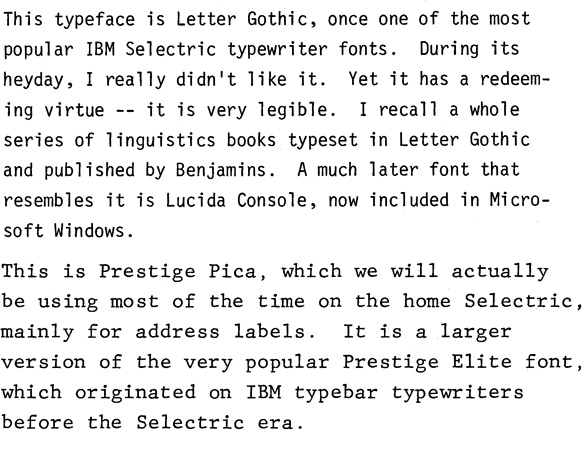
From the new Selectric II, a couple of type samples,
10 and 12 pitch respectively, 1.5-spaced.
(The older typewriter is only 12 pitch and doesn't do 1.5-spacing.)
I'm still trying to
decide whether I like or hate Letter Gothic.
I think part of what's going on is that styles have changed, and it doesn't look
as strange in 2010 as it did in 1970, because we see more of its relatives.
Permanent link to this entry
|
2010
February
9-10
|
Short notes
Selectric II No. 2 is here — that is, my second Selectric II typewriter, bought
off eBay a couple of weeks ago, is back from the maintenance shop and works fine. Now we can
type address labels properly at Covington Innovations.
What if someone lists you as a co-author of
a scientific paper and you didn't actually co-author it?
Click
here for some expert advice about what to do.
Believe it or not, this actually happens; a young scientist often wants to pick up
prestige by including a distinguished co-author, or believes mistakenly that all the
scientists in the lab have to be listed as co-authors.
Although I would object to anyone doing this to me, I don't think I would
take any further steps unless the misattributed paper either (1) was shoddy work
that I didn't think would hold up, or (2) contained opinions that I can't endorse.
Permanent link to this entry
|
2010
February
8
|
Don't believe everything you hear
Political falsehood of the day: "The government is going to confiscate your retirement savings."
This was done in Argentina, but there is
no
proposal to do it in the United States, and in fact our
Constitution does not allow it. Yet it's one of the many falsehoods constantly being dished out by
so-called "conservative" talk radio. For some reason, this particular rumor, which first popped up
in November 2008, is all of a sudden getting passed along again.
Another example: The other day Rush Limbaugh said, or at least gave the impression, that Obama was trying
to do away with the tax deduction for charitable contributions. The Washington Post told me he was
just wanting to cap it at 28%.
Also to be distrusted are advertisements that mention Obama, saying that he says you can get
"bailed out" of your credit card debts, or the like. There's no reason the president's picture should
be in any commercial advertisement.
Future generations will laugh at a lot of what's in the mass media this year.
Permanent link to this entry
Latest addition to the web site
Whenever I gather information about anything, I give it back to the public.
So this had to happen,
and did. More material will be added.
Permanent link to this entry
|
2010
February
7
|
Intelligence test
I've seen people express puzzlement about this or declare that the data must be fake. No...
How can it be that job losses are up but unemployment is down?
Click here if you can't figure it out.
Permanent link to this entry
|
2010
February
6
|
Anatomy of an incendiary blog post
Click here
for an amusing (and very classical)
piece of classical rhetorical analysis.
Permanent link to this entry
|
2010
February
5
|
And...
And today there was something worse than a scandal:
a stabbing at Georgia Tech (75 miles from us
and under the same Board of Regents). Academic life may not be
as safe as we thought.
Permanent link to this entry
|
2010
February
3-4
|
Two scandals
Today I had to tell my research group about two scandals:
an international one
about falsified medical research that supposedly indicated
that the MMR vaccine causes autism,
and a local one
about one of our computer security people
who got arrested for extortion.
Concerning the first one: England's strict libel laws are keeping The Lancet
from saying anything very clear about why they retracted the paper.
Other media report that the data were actually falsified.
The whole episode is sad for several reasons: children died because they weren't
protected from measles, and for years to come, plenty of people
will not be smart enough to stop believing in a hazard for which there
was never any scientific evidence, and will continue exposing their children
to the real hazard of measles to avoid the imagined risk of autism.
Concerning the second one: Computer security is law enforcement and needs the same
kind of safeguards against employee misconduct. And we need to put out the word,
very loudly, that the University does not automatically swallow every accusation
against a student that it receives from the outside world. Students have a right to due process,
and in fact a right not to be bothered at all if there is no credible probable cause.
No individual University official will swoop down on an individual student and impose punishment.
Ever. That's not how it's done.
Permanent link to this entry
|
2010
February
2
|
Health insurance reform?
CNN reports: "Democratic efforts to pass a health care bill have stalled a bit,
and the immediate focus may be shifting toward health insurance reform
instead of quickly trying to pass a comprehensive bill, White House officials signaled Sunday."
I hope so. Here's what I think we need:
(1) To decouple health insurance from employment so people don't lose their insurance
when they change jobs.
(2) To give people a wider selection of insurance plans, including the ability to buy
across state lines.
(3) Some kind of tort reform. In dealing with malpractice, compensation of the victim
needs to be separated from punishment of the doctor; the latter is largely a matter of
licensing. Because of liability insurance, the costs of malpractice judgments are spread
across all doctors, not just the bad ones, and do not actually punish the guilty.
(4) A must-have, must-carry system health insurance system,
so that everyone can get insurance, and everyone has
to do so. This would be totally private but heavily regulated.
As I said earlier, this is the only way to get around the "pre-existing condition"
problem, and the only way to make it affordable is to require everyone to have insurance,
even when they're completely healthy.
Of these, (1), (2), and (3) are "conservative" and (4) is "liberal." But notice that
I didn't say the government should go into the insurance or health care business.
Not at all. What I advocate is a system like that of Switzerland or the Netherlands,
where, in fact, even Medicare is not needed because everybody has private insurance.
Some people argue that the government has no right to require you to buy insurance.
Yet it surely has the right to tax you and give you insurance — nobody
claims Medicare is unconstitutional. Surely you have more freedom when you're making
a required purchase (from a provider of your own choice) than when you pay a tax for
a government service.
What isn't possible is what some unsophisticates want: "I'm not paying a penny for
insurance until I get sick, and then I have to be able to get it regardless of
pre-existing condition." That, folks, is not insurance. You don't shop for car
insurance after the wreck. You don't shop for life insurance after you're dead.
Permanent link to this entry
Short notes
How it works:
Remember my account of a hat
that attracts women? The other day I got a small indication of how it works.
I was putting on a somewhat similar hat after lunch in a restaurant, and a
3-year-old girl looked up, pointed at me, and said, with delight, "Oooo! Cow-boy!"
Hmmm... Now I know how to impress 3-year-old girls.
The oddest thing I've read about lately:
How to
hypnotize chickens.
Is it even possible to hypnotize
humans? Look at all the skepticism in recent accounts such as the one I just linked to,
and especially the now-widespread consensus that stage hypnotism is mostly fake.
Apparently, hypnosis is a state of heightened concentration (not unconsciousness or enslavement) into which
some people can be put. But it doesn't work reliably. If it did, we'd be seeing it used
therapeutically for all kinds of purposes, including anesthesia.
Permanent link to this entry
From the typographical zoo
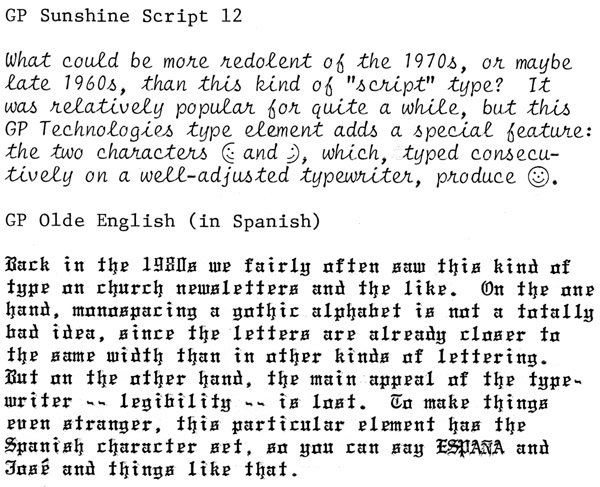
A couple of unusual Selectric type elements that have recently come my way:
Permanent link to this entry
|
2010
February
1
|
Short notes
This blog got over 13,000 hits in January. Those are split across all existing material, so I don't
know how many people are reading it regularly. But I am again experimenting with Google Ads.
If you like software but don't like programming, consider
getting a job as a software tester.
Apparently, last month I stumbled into a
cultural phenomenon
called typecasting namely
creating
blog entries on a typewriter and scanning them.
I didn't mean to be taking a position in a modern literary movement.
I just wanted to show you some typefaces.
(I wonder if they realized that typecasting already meant something else,
and also that the contents of a scanned typewritten blog entry are invisible to
Google. Hmmm... maybe they're shy about search engines.)
Speaking of typefaces, I recently bought (on eBay, where else?) some curiosities from
the liquidation of GP Technologies, an early-1980s third-party maker of custom
Selectric type elements. In the next few days I'm going to show you a typographical zoo,
including "Olde English" in Spanish, and a typeface that can type smiley faces.
And does anybody out there need an OCR type element
with a Belgian (Dutch/French) character set?
A ghost in the history of typewriters: Was there ever
any such thing as a "Smith-Corona Selectric"?
I saw an ad for one, but the advertiser thought he might have mixed up the names.
Googling, I find the phrase "Smith-Corona Selectric" scattered here and there, but never
with a clear indication of what machine it denotes (or occasional definite
misunderstandings). Selectrics were made by IBM;
portable typewriters were made by Smith-Corona; and as far as I know, the two never
crossbred. But I know that a close imitation of the Selectric typewriter
was built (right after
the patents ran out) by Remington Rand, and that "Selectric" was a trade name for other
things (electric shavers, boat motors) made by various companies.
The weight of the Google evidence, scant though it is, seems to be that some people
though "Selectric" was a generic term for "electric typewriter" or something of the sort.
If so, we have a clear case of metonymic meaning change as described by
Rulon Wells in 1975 paper, "Metonymy and Misunderstanding." Sometimes a word changes meaning
when people misunderstand it and get away with it.
Permanent link to this entry
|
|
|
This is a private web page,
not hosted or sponsored by the University of Georgia.
Copyright 2009 Michael A. Covington.
Caching by search engines is permitted.
To go to the latest entry every day, bookmark
http://www.covingtoninnovations.com/michael/blog/Default.asp
and if you get the previous month, tell your browser to refresh.
Entries are most often uploaded around 0000 UT on the date given, which is the previous
evening in the United States. When I'm busy, entries are generally shorter and are
uploaded as much as a whole day in advance.
Minor corrections are often uploaded the following day. If you see a minor error,
please look again a day later to see if it has been corrected.
In compliance with U.S. FTC guidelines,
I am glad to point out that unless explicitly
indicated, I do not receive payments, free merchandise, or other remuneration
for reviewing or mentioning products on this web site.
I have a Canon EOS 20Da camera and a Tektronix
TDS 210A oscilloscope on long-term loan from their manufacturers. Other reviewed
products are usually things I purchased for my own use, or occasionally items
lent to me briefly by manufacturers and described as such.
|
|