|
|
|
| |
|
2012
February
29
|
Leap!
Happy leap year day!
As everybody knows, the reason we have leap year is to keep the seasons from
slipping relative to the calendar.
If we didn't have it, the shortest day of the year would slowly drift
forward from December 21, the late January thaw would move into February,
and so forth.
Julius Caesar introduced leap year in order to make the year
365 + 1/4 = 365.25
days long. That's not quite right, and Pope Gregory changed the rules for
century years so that the calendar year is now, on average,
365 + 1/4 - 1/100 + 1/400 = 365.2425
days long, but that still isn't perfect.
The actual orbital period of the earth around the sun is
365.2422 days, so in about 3000 years, we're going to have to have
another adjustment. As I recall, this adjustment was written into
the laws of the Soviet Union so that they could proudly say they were
not using a calendar made up by a Pope.
I'll see you in March — possibly not right at the beginning
of the month, since I'm very busy!
Permanent link to this entry

|
2012
February
27-28
|
Multi-level marketing
Superseded by my entry for January 31, 2013.
Please click through and read it.
Permanent link to this entry
|
2012
February
22-26
|
I'm still here...
No, I haven't vanished or met some untimely demise. Yes, I've been very busy writing
two research papers that I hope to be able to share with you. In the meantime, a few interesting
links...
If you think religious people shouldn't be allowed to meddle in politics,
think about how
slavery got abolished.
What are we to make of
"Modern
Monetary Theory" (MMT), which claims that government deficits are desirable, even necessary for prosperity?
I'm not convinced. Note this
person's arguments that MMT uses a strange definition of "saving," and in fact
that personal saving is possible without a government deficit, indeed without money at all.
(Note however that the latter essayist is almost as far from the mainstream of economic thought,
in the opposite direction.)
Professor Ruth Barcan Marcus
has died. I took her logic course at Yale and wrote this term paper
for it. She is one of the most eminent scholars from whom I ever took a course.
Finally, here's someone else
who objects to the overuse of digital special effects in photography
(what I was calling "hipster photography"), but he doesn't state his case very well —
it looks like much of his essay may have been chopped off by the editor.
But let me counterbalance that by adding — loudly — that
there is no such thing as an "unprocessed" photograph.
Some people have apparently been lulled into thinking that what comes out of the digital
camera is "the truth" and any processing done afterward introduces falsehood.
Falsch. Whenever a picture is made, decisions have to be made about the brightness range
and color balance. In the old days, that's what darkroom work was all about.
Nowadays the decisions are often made automatically by computers — even the
computer inside the camera — but they are still decisions. If you ever
attempt any astrophotography, you immediately run into situations where the computer doesn't
know what it's doing and you have to override it and make different decisions.
Permanent link to this entry
|
2012
February
19-21
|
Would those "fake bonds" fool anybody at all?
[Updated; pictures added.]
You've probably seen the news media's coverage of
$6
trillion of fake U.S. Treasury bonds
recently found in Switzerland by Italian police.
Take a close look...
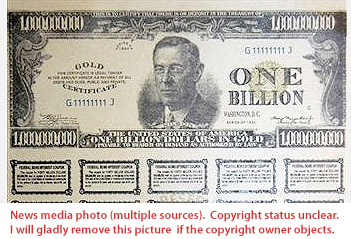
I'm not familiar with Treasury bonds. But this one looks especially dubious.
It's laid out like a bond, with coupons. I can't read the print on the coupons in the picture.
The denomination is a whopping $1 billion. For one bond.
Presumably, the box contained six thousand of them.
If genuine, they would have covered half of our present national debt.
The design at the top is shaped like a dollar bill,
and it has the words "Gold Certificate" and "This certificate is legal tender..."
which a bond wouldn't have. Bonds aren't gold certificates and aren't legal tender.
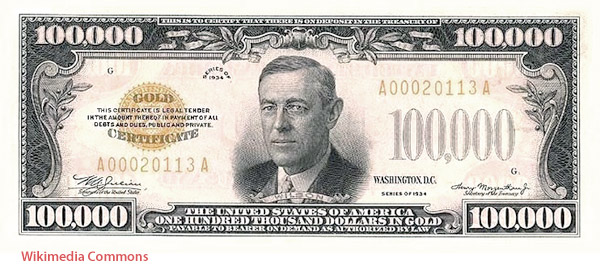
Those words, along with the picture of Woodrow Wilson, the 1934 date,
and the overall design, appear to have been
copied from the $100,000 Gold Certificate of 1934,
which is the highest-denomination U.S. paper money ever printed.
At this point everybody except the Italian police should be laughing.
Are these really counterfeit bonds, or are they something else —
like a joke, or a theatrical prop?
I'm thinking of the ersatz Bank of England
million-pound notes that were printed to promote a movie, about 50 years ago,
based on Mark Twain's story "The Million-Pound Note." Some of them were on sale at Coincraft last
time I looked. I think I'll buy one and hang it on the wall, just to make people wonder...
Permanent link to this entry
|
2012
February
18
|
Was that question misleading?
Two people have told me that question 3 on that financial literacy test, which I reprint
here for convenience...
- 3) Let’s say you have 200 dollars in a savings account. The account
earns 10 percent interest per year. How much would you have in the
account at the end of two years?
makes it clear that interest is compounded annually. "Per year," isn't it?
I can understand why some people take it that way, but I don't think it actually
says that. It doesn't even rule out simple interest.
Thinking about this, I realized that maybe I know too much.
There's never been a savings account that pays 10%, as far as I know.
But I've had them paying 5%, and always compounding a lot more than once
a year. My present super-low-interest savings account compounds quarterly.
Back when interest rates were competitive, savings accounts would often compound
daily or even continuously.
So maybe that question penalizes me for knowing too much about banking.
I know that the compounding period is important.
Other people may not.
Test questions should never penalize knowledge.
That happens when an example is unrealistic or ill-defined and a knowledgeable
person is motivated to "correct" it, or at least question it,
but the examiner wants them to take it literally.
Permanent link to this entry
|
2012
February
15-17
|
A misleading test of financial literacy
The New York Times has an excellent
economics column.
They recently reported on
NBER
Working Paper 17821,
by Annamaria Lusardi, which in turn reports that adults
(specifically, Americans around my age) did terribly on the
following financial quiz:
- 1) If the chance of getting a disease is 10 percent, how many people out
of 1,000 would be expected to get the disease?
- 2) If 5 people all have the winning number in the lottery and the
prize is 2 million dollars, how much will each of them get?
- 3) Let’s say you have 200 dollars in a savings account. The account
earns 10 percent interest per year. How much would you have in the
account at the end of two years?
- 4) In a sale, a shop is selling all items at half price. Before the sale, the
sofa costs $300. How much will it cost on the sale?
- 5) A second hand car dealer is selling a car for $6,000. This is two-thirds
of what it cost new. How much did the car cost new?
Well, I grant that questions 1 and 4 are fair. Question 5 might be slightly challenging
to a minimally educated person whose arithmetic is rusty, since it involves dividing by a fraction,
and also because the correct answer is an unrealistically low price for a new car.
But on questions 2 and 3, I cry foul.
Question 2 assumes that the prize in the lottery is divided equally among the winners,
but that isn't stated. A person who doesn't play lotteries might simply not know what
happens when there are multiple winners — maybe the prize is duplicated for all
the winners, or something.
And question 3 absolutely does not say how often the
interest is compounded, so it's unanswerable.
So if you're looking for 51-to-55-year-olds who can't answer all the questions on
this list, count me in, even though I have maybe three times as much formal education
as your target demographic.
Permanent link to this entry
Short notes
Want to know what goes on inside a computer, and how you get from electric circuitry
to programming? Read
Code, by Charles Petzold.
A bothersome thing about our post-9/11, not-quite-so-free country is that there are
increasing, haphazard restrictions on
taking
pictures in public places. Can I still play tourist in my own country? What's worst, the rules don't seem to be clear.
And here is
some interesting information about growing consumer debt in America.
Relative to take-home pay, household debt started growing steadily around 1984 and has grown ever since.
Before that time, debt kept pace with income, as it should.
Here is somebody
besides me arguing, finally, that student loans ought to be dischargeable by bankruptcy, as they were in past decades.
The problem is, the lender ought to take some of the risk for irresponsible lending, and with federally
guaranteed student loans, that risk is totally taken out of the picture. As a result, colleges
have an incentive to push people to borrow life-destroying amounts of money.
I remain extremely busy and will write Notebook entries only once every few days.
Rest assured I'm thriving and prospering!
Permanent link to this entry
|
2012
February
11-14
|
Two unusual photographs


Following up a conversation on Facebook, I want to point out that I don't require all
photography to be perfectly "straight" and illustrative.
I like abstract and semi-abstract patterns; I've even taken photographs that are not
recognizably pictures of anything at all.
Here are two that are out of the ordinary, though not abstract.
The first one is the University of Georgia Founders' Memorial Garden,
photographed on Infrared Ektachrome in 1975 (probably without the yellow
filter that was recommended; hence too much pink). This false-color image
later inspired a painting by Melody.
The second one was taken in 1972; it shows a pond drying up after being drained.
This is northwest of Winding Way in Valdosta and is now a residential area.
Kodachrome-X, Mamiya/Sekor 1000 DTL with P.R.O 135-mm f/2.8 lens.
Happy St. Valentine's Day, Melody, Cathy, and Sharon!
Permanent link to this entry
|
2012
February
10
|
Busy!
Besides having twice the normal number of students, I have
two major research papers to write this month.
That means I won't be blogging much.
Nor can I take on any more activities — neither projects
nor social events — until at least mid-March.
Please bear with me.
Permanent link to this entry
|
2012
February
7-9
|
A few interesting things on the Web
Good resources on sentiment analysis,
the kind of natural language processing that I do a lot of.
Short stories by Charles Dickens,
whose 200th birthday was the other day.
Some
background on the financial crisis as reflected by household borrowing.
Finally,
the dollar coin has some advocates besides me.
Permanent link to this entry
|
2012
February
6
|
New instrument on the workbench
 Over the years, a number of interesting things have happened
to me as a consequence of going to church, but yesterday (Feb. 5)
was one of the most unusual.
Over the years, a number of interesting things have happened
to me as a consequence of going to church, but yesterday (Feb. 5)
was one of the most unusual.
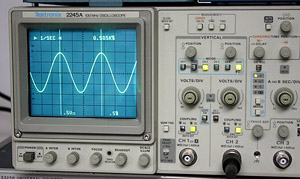
I sat next to my friend Lewis Noles (of UGA EITS) and his wife Raynette, and after
the service, she asked me if I'd like to have an oscilloscope she had just
inherited from a relative. I said yes, and to my delight it was a Tektronix 2245A
(100 MHz, 4 channels, cursors with digital readout), 25 years old but
in immaculate condition. THANK YOU!
Permanent link to this entry
A flurry of interesting things
Some reading matter for the next few days...
Communism is hard to get over —
when it's removed, the workers simply don't know how to be productive in a free environment.
Economies typically stagnate until a new generation of workers enters the workforce.
Closer to home, the IRS publishes its manuals for auditors.
Index here.
The biggest thing the auditors are looking for is
businesses that aren't really businesses, such as hobbies that generate a tax loss.
They also do battle with widespread misconceptions, such as the notion that you can deduct
your entire house if you put some business records in each room.
Here is a good reflection
on what killed Kodak. Basically, Kodak was so convinced that it was here to stay that it did
not appreciate its own mortality. And Kodak relied on making people pay for things they didn't
really want — such as 24 pictures every time you wanted just a few. Digital technology
came along and knocked it down. "Look
on my Works, ye Mighty, and despair!"
And I'm not the only person in the world who thinks
inflation
is coming,
and when it comes, it will start suddenly.
Survival tactics: Lock in low, fixed interest rates on all your debts, and don't get overextended.
Permanent link to this entry
|
2012
February
5
|
Pro-life and pro-hope
Please click through and read
Eastern Orthodox writer Frederica Mathewes-Green's
essay about the abortion issue.
Some key points:
- The early Christians opposed — and eventually overthrew — a Greco-Roman culture
that was very permissive of abortion and the abandonment of infants.
Christians' love for infants so annoyed their persecutors that the persecutors tried hard to
falsify and misrepresent it.
- American public opinion is swinging against abortion, and this seems to be unconnected with
political or religious debate. Maybe it's because a generation of people are coming of age who
realize that they
themselves could have been aborted.
In fact I wonder if the Sexual Revolution today is starting to be viewed
like cigarette smoking in 1975: it was the previous
generation's fashionable new toy, but now a younger generation is arising that views it as the folly of their
elders. Young people do not respect irresponsibility on the part of their parents' generation.
- Women don't want abortions — their boyfriends or parents want abortions. At least, that is a very
common scenario. Abortion is the magic eraser by which someone else conceals what has been done to
a woman, and if she objects, they say she's not a good feminist.
I am against abortion for the same reason I am against slavery.
It's not primarily a religious doctrine — it's a matter of human rights.
To justify slavery or abortion, you'll have to convince me that a slave or a fetus,
respectively, is not a human being
(which would imply that a premature baby isn't either).
It is not enough just to say that people demand abortion, or some of them might resort
to gruesome alternatives. If you say abortion must be permitted for the sake of women's
lifestyle freedom, you're on the same level as the people who argued that slavery
had to be permitted because it was necessary for Our Southern Way Of Life.
Permanent link to this entry
|
2012
February
1-4
|
Short notes for a new month
It's February 3 as I write this, and I'm proud
to have "done my income taxes" (that is, prepared a large pile of information
for the accountant — now he has to do his wizardry
with depreciation and other such arcane matters).
While trying to keep with such things, I found this delightfully precise quote in
IRS Publication 535:
"Amounts spent for tools used in your business are deductible expenses if the tools have a life expectancy of less
than 1 year or their cost is minor."
So what is "minor"? They never define it. Nobody has ever expected me to inventory every stapler and
mechanical pencil (even though they have useful lives greater than a year). But what is an appropriate
threshold for capital equipment? $100? $1000? There are businesses where anything under $10,000 is "minor,"
and other businesses where hardly any single piece of equipment costs more than $50.
It is for such things that we need accountants who know what the IRS actually accepts.
The other day I was inveighing against
"hipster photography,"
and today a fine
example of it came my way.
You may even be able to see it
at this link.
We had an unusual, warm, spring-like day and the University's press office wanted to tell us how pleasant it was.
So they snapped a picture with an iPhone — which should have been plenty good enough — and then
"filtered" it to make the blue sky yellowish-gray and to blur the top and bottom of the picture as if it had
been taken with pre-1900 lens technology.
And they made our campus look like Los Angeles in a killer smog. Being a grumpy old faculty member, I grumbled about it.
Permanent link to this entry
|
|
|
This is a private web page,
not hosted or sponsored by the University of Georgia.
Copyright 2012 Michael A. Covington.
Caching by search engines is permitted.
To go to the latest entry every day, bookmark
http://www.covingtoninnovations.com/michael/blog/Default.asp
and if you get the previous month, tell your browser to refresh.
Entries are most often uploaded around 0000 UT on the date given, which is the previous
evening in the United States. When I'm busy, entries are generally shorter and are
uploaded as much as a whole day in advance.
Minor corrections are often uploaded the following day. If you see a minor error,
please look again a day later to see if it has been corrected.
In compliance with U.S. FTC guidelines,
I am glad to point out that unless explicitly
indicated, I do not receive payments, free merchandise, or other remuneration
for reviewing or mentioning products on this web site.
I have a Canon EOS 20Da camera and a Tektronix
TDS 210A oscilloscope on long-term loan from their manufacturers. Other reviewed
products are usually things I purchased for my own use, or occasionally items
lent to me briefly by manufacturers and described as such.
I am an Amazon Associate, and almost all of my links to Amazon.com pay me a commission
if you make a purchase. This of course does not determine which items I recommend, since
I can get a commission on anything they sell.
|
|