|
|
|
| |
|
2012
May
29
|
Our American freedom
I let Memorial Day go by unremarked. To my foreign readers I should explain that it is
the day we honor those who risked, and in many cases, lost their lives in combat for our
freedom.
I don't love war. War is terrible and to be prevented whenever possible.
As I often say about my defense-related research, you never hear about the wars we prevent.
But as Jeff
Duntemann puts it, we have to admit that evil is real and sometimes has to be opposed with
deadly force. I think it was Orwell who said that if you don't believe in defense, you
should see if you like living in a place that doesn't have any. I know it was Eisenhower
who expressed amazement at the way American soldiers under him were willing to die so
that other people, even whole other countries, could be free.
We have almost forgotten what this freedom is. Mention liberty to an American today,
and he will probably, quite properly, talk about keeping our own government out of our hair.
But we have forgotten what a lot of the fighting was about: lack of oppression
by foreign powers. We can complain bitterly about our own government.
We take it for granted that we don't have to complain about anybody else's.
When we have a political controversy, it's because we are divided about
something, not because we object to something an outside power is forcing upon us.
We have that freedom because people have been willing to die for it.
Think about that a while.
Permanent link to this entry

|
2012
May
28
|
Trade-offs in planetary photography
The trouble with Saturn is that it's a long way from the sun and is therefore dim.
Saturn is 10 times as far from the sun as we are,
so the sunlight shining on Saturn's surface is only 1/100 as bright as here.
That means the surface brightness of Saturn is low, whether you view it from here or
from a space probe. (Recall that light-source-to-subject distance affects exposure
but camera-to-subject distance does not; if it did, the horizon and the foreground in
sunlit terrestrial landscapes would not be correctly exposed at the same time.)
Saturn is so far away that, to get a decent-sized image with my telescope, I have to
use it as either a 3000-mm f/30 lens or, with a bit less magnification but a brighter image,
2000-mm f/20. This is an 8-inch telescope. If I had a 16-inch, I could work at f/15 and f/10
respectively and get a much brighter image.
As it is, Saturn is just barely bright enough for me to photography using the standard
technique, which is to records hundreds or thousands of very short exposures with a video
camera, then sort and stack them.
And the subject of last Friday night's experiment was how best to do this. Which is better,
a lot of short exposures (to "stop" the turbulent movement of the air) even if they are
underexposed, or longer exposures that are less numerous? And what happens if I go to
lower magnification and shorter exposures?
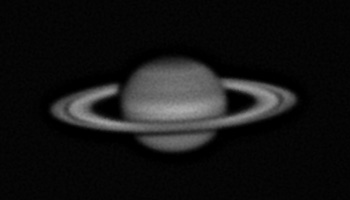
First, here's an infrared image. The exposures were 1/4 second and I was only able to
record 450 video frames. As with all the others, the best 90% of the frames were stacked
with RegiStax, aligned, and postprocessed with Photoshop, which usually included some
speckle removal.
Now for some color imaging. The general principle here is that taking a larger number
of frames reduces grain (noise); more generous exposure also reduces grain; and I'm wondering which
does more good. Here are about 900 frames each exposed 1/9 second at f/30:
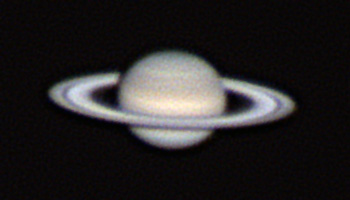
These were rather underexposed. They don't look dark because of the postprocessing, but I
switched to f/20 and was able to get much better exposure (still at 1/9 second):
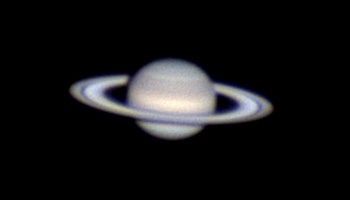
But there's some blur because 1/9 second is still rather long for a planetary exposure.
What would happen if I went to 1/18 second and recorded twice as many frames, even
though they would all be seriously underexposed? Surprisingly, I got this:
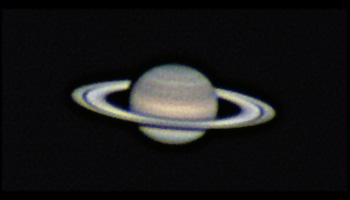
I got more detail but also more grain. What I really need is a camera about four times
as sensitive to light, or a bigger telescope.
Permanent link to this entry
|
2012
May
27
|
Plastic wire insulation contains lead
I was about to give some old, colorful scraps of telephone wire to an art teacher
for children to use in art projects. But then I vaguely remembered something...
and looked it up... here.
The plastic insulation on wire often contains enough lead to be dangerous when chewed.
Most people don't chew on wire, but children may, and most people would not imagine
there's a hazard, since similar plastics are used to make children's toys and the like.
The difference is, those plastics don't have to withstand high temperatures the way
insulation does. Lead is found in the insulation on wire, but not in similar-looking plastics made
for other purposes.
I don't actually know whether the insulation on telephone wire from 30 years ago actually contains
dangerous amounts of lead. But since it was made before the hazard was noticed, I'm erring
on the side of caution.
Permanent link to this entry
|
2012
May
26
|
Where to get Polaroid flip-up sunglasses
As sophisticated shoppers know, fashionable clip-on sunglasses now attach to the edges of
your prescription glasses, not in the center, and they require two hands to put them on
or take them off. That is not satisfactory for driving into parking garages or tunnels —
one needs to flip them up with one hand on a moment's notice. That is also why I use clip-ons
rather than prescription sunglasses. I have to be able to switch modes quickly.
The other day, the only clip-ons that I could find in a Wal-Mart's optical department
were the side-clip kind. I duly paid $16 and decided to put up with the inconvenience.
A few days later, I strolled through the sporting goods section of a different Wal-Mart
and saw this:
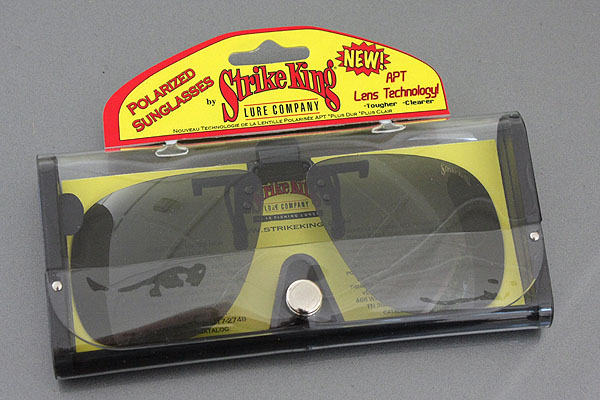
Just what I needed, and priced right ($7).
They had classified it as fishing tackle, not eyeglasses.
I know they look dorky. I'm a computer scientist and am over 50 years old.
The first of those is a reason, and the second is an excuse, to look dorky.
Permanent link to this entry
More about that Maytag repair
The most satisfying part of the repair was actually making a new knob to fit the
new shaft, which was a different diameter than the old shaft
(and anyhow, the old knob had the broken-off shaft stuck in it).
Along the way, I had an insight about ergonomics:
That flimsy little switch (with no bushing to absorb lateral force)
should never have had a big 2-inch knob on it.
Although Melody is careful, other owners of the same model of washing machine
would probably have taken the big knob as a signal to apply lots of force.
A delicate switch needs a small knob.
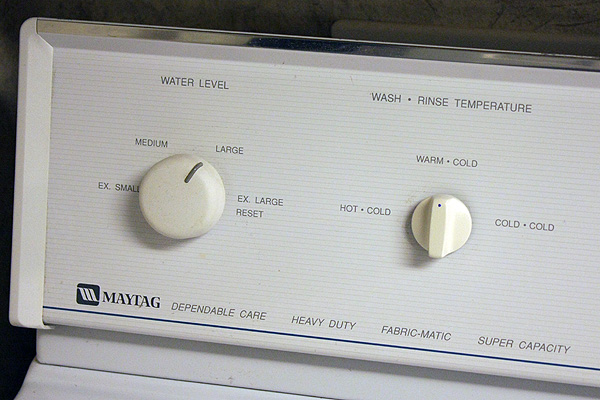
So I found an old, small knob that fit the new shaft, then spray-painted it to match the
washing machine and added a dot using a Sharpie.
The new one, Melody says, looks better than the original:
Permanent link to this entry
|
2012
May
25
|
How I fixed the washing machine
See also next entry.
The knob came off one of the controls of our washing machine the other day.
Unfortunately, it didn't come off in the normal way.
The shaft broke off.
Melody called our appliance repairman, but he was unable to get an exact
replacement for the broken switch. So then it became my job.
It was the 3-way selector switch for hot, warm, or cold water.
Removing the control panel, I was delighted to find a circuit diagram
folded up behind it.
Here's roughly what we're dealing with:

(That's my diagram, not theirs. Key idea: Hot water on for hot;
cold water on for cold; both on for warm.)
This is implemented with a custom-made rotary DP3T switch.
DP3T switches aren't the most common things in the world, and no
rotary DP3T switches of suitable size seem to be on the market nowadays.
I found a DP3T toggle switch that I'll order if it comes to that.
But what I actually did was drill into the broken shaft and epoxy a
metal rod into it. That may hold for the life of the machine.
And once again I have the satisfaction of having made
something work.
Permanent link to this entry
|
2012
May
23-24
|
A screwy, nutty matter
I'm expecting to get into my electronics workshop a little this summer — which didn't
happen last year, or the year before — and I'm modernizing it a bit.
You've already heard about the Arduinos. There are now three of them waiting to be
experimented with.
On a much more mundane level, while mounting one of the Arduinos on a wooden block, I realized
I need to stock nuts and bolts smaller than the common American #6-32 size (which fits
in a 5/32-inch hole). For all my life, from my first Erector set in 1960,
#6-32 has been the size for screws in small pieces of equipment.
But not any more. It's not small enough for a lot of newer miniaturized gear. I thought about
stocking up on the next smaller size, #4-40, but it never became all that common in the United
States, and I decided instead to stock up on M2.5×0.45, which is a metric size that has
long been extremely common in Japanese equipment. It's 2.5 millimeters in diameter and
(for us Americans) fits in a 7/64-inch hole.
M2.5 nuts and bolts are available through Amazon, but the prices are much lower if you order
from www.nutty.com. I'll let you know about the service
and quality when they arrive.
By the way, what is the difference between a bolt and a screw?
Bolts are tightened by turning the nut; screws, by turning the head.
It follows that a Phillips-head machine screw and a Phillips-head machine bolt are the same thing.
Now you know!
Permanent link to this entry
|
2012
May
22
|
Arduino
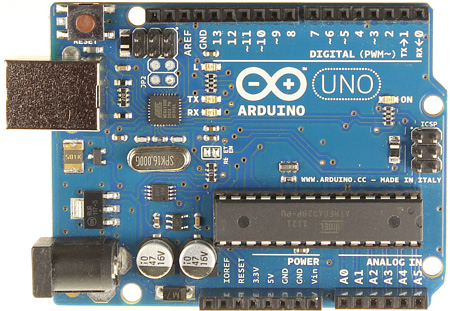
I have a new hobby, or subspecialty, or something: Arduino microcontroller programming.
I've been aware of the Arduino project for some time, but today (March 21), prodded
by some graduate students, I took the plunge and bought some Arduino hardware.
An Arduino is a high-end Atmel AVR microcontroller, plus support circuitry (crystal,
voltage regulator, etc.), and, most importantly, the thing it most needs — a USB port.
The USB port is used for programming, and, optionally, for power and for communication
with the host PC.
There is also an extremely user-friendly development environment. The programming
language is C with a preprocessor. Most Arduino programming is extremely easy for a person
who already knows how to program a PC in a similar language. They've done what most needed
to be done — redefined the programmer's job. Instead of poring over manuals looking for
the exact effect of setting bit 3 of port D, the programmer thinks about what needs to be done
and the algorithms for doing it. That's what programming languages are for.
This is a paradigm-changing advance. In the past, there have been three main ways to program
microcontrollers:
- In assembly language. I've done plenty of this, reading manuals for hours and constructing
simple programs painstakingly. I've done this on the 8051 series, the PIC, the 68HC11, and
the AVR series.
- In C. This is easier, but not a lot easier because C is normally just a more concise
way of expressing the same arcane codes. You still have to study the CPU architecture in detail
and think in assembly language, even while coding in C.
- In various interpreted languages, as on the Basic Stamp and the PICaxe. As I understand it,
these confine you to a small, special-purpose system, and you don't get the full speed or
memory space of the processor.
The Arduino's programming language is compiled, not interpreted, and the compiler spares you having
to keep track of architectural quirks. It does for the AVR what Fortran did for IBM mainframes
in 1958. It is what IBM used to call a "problem-oriented language."
There is a smooth "downgrade path" from the Arduino to plain Atmel AVR programming.
The chip on the Arduino Uno board is in a socket; you can pull it out, equip it with a crystal
and a couple of resistors and capacitors, and run it elsewhere (without a USB port).
Going the other way, if you like the Arduino board but not the Arduino bootloader and
programming language, you can program the chip via AVR ISP with any code you want,
even assembly-language programs.
AVR daughterboards are called "shields" and comprise an amazing variety of things,
with open-source software to access them from the Arduino's preprocessed version of C.
There are Ethernet ports, gyroscopes, motor controllers, and cell-phone-style full-color
graphical displays.
There's only one thing I don't like so far. The development environment doesn't have a Windows
installer. You're apparently supposed to keep it in your user file space (mine is on my Windows
desktop). Actually, I can fix that. Maybe that will be my contribution to the Arduino project.
It might not be too much to say that Arduino is the IBM PC of the microcontroller world.
Recall that the IBM PC, back in 1983, was the first microcomputer that really appealed to
mainframe programmers. It was programmable in a variety of compiled languages (vs. the Apple II's
interpreted BASIC), it followed pre-existing standards, and most importantly, it was expandable.
As a result, it created a standard for the future.
The essence of the Arduino project has been the realization that until now, microcontrollers
have been way too hard to program, and we can do something about it — not with a "baby"
interpreted-language environment for beginners, but with an efficient programming language that
gives full access to the machine's power while dispensing with the needless tedium.
Permanent link to this entry
|
2012
May
19-21
|
Downgrading the University
The newspapers
are finally reporting
what I already knew: The State of Georgia started cutting its funding for education
long before the recession.
According to this report, per-student funding for the University System,
adjusted for inflation, has declined 58% in the past ten years.
That accounts for sharply rising tuition and fees, as well as the growing expectation
that faculty members will get grants — as if there were a bottomless well of
federal funding to draw on. Anyone who thinks the federal budget isn't in for some
cuts hasn't been reading the news.
Permanent link to this entry
|
2012
May
18
|
Farewell, Art Zorka
One of the Atlanta Astronomy Club's most well-liked and colorful characters
died suddenly and unexpectedly last night (May 16). Art Zorka was a noted
photographer, stage magician, and amateur astronomer, serving as our Astronomical
League liaison and keeping up a flurry of worthwhile activity. I first met Art
before I was in the Club; when working at CompUSA back in the mid-1990s, he sold
me my first digital camera, a Sony Mavica. Or maybe my second, a Nikon 800D.
He will be missed.
Permanent link to this entry
"Someone left the cake out in the rain..."
We also note the passing of singer Donna Summer, and the news of this led me to
listen to her performance of "MacArthur Park" (a song from the 1970s) and to read
a bit about the story behind the song.
It is, of course, a song about a failed relationship. But it was not intended to
have weird psychedelic metaphors. The details in it are literal, although much of
the audience did not know the context. In particular, "someone left the cake out
in the rain" is not a bizarre vision — it is the composer's recollection of
an abandoned children's birthday party setup that he saw in MacArthur Park (Los
Angeles). Having lived in Southern California, I can tell you that the locals seem
to think it will never rain, and they often leave furniture and other things outdoors
and then are surprised when the rain damages them.
Now you know.
Permanent link to this entry
|
2012
May
17
|
A small point of C# style:
A class and an instance of it can have the same name
In one of my large computer programs there was an object called Analysis
(actually a field of another class), and it was of a class called AnalysisInfo.
After some thought I concluded that AnalysisInfo is a silly name —
it's like saying AnalysisClass or AnalysisType — and I changed it to
Analysis. Now the class and the instance have the same name.
Some purists may cringe, but actually, I've done nothing undesirable.
The C# language is carefully designed so that class names and object names
are always distinguishable. They even come up in different colors in the editor.
A classic example is that various graphical objects have a property called
Color whose type is also called Color. It would be silly to call them
ColorValue and ColorType or anything like that.
Also, it is quite reasonable for the type of an enumerated variable to have
the same name as the enumeration. Then you can say things like
Color c = Color.Red;
MyRectangle.Color = c;
and so forth. See also this.
Permanent link to this entry
|
2012
May
16
|
It's time to spam-filter the telephone!
This will seem obvious in retrospect. Just like e-mail,
telephone calls ought to be spam-filtered. That would do a
great deal to rid us of pesky robocalls, bogus charities, and
phishers.
Telephone networks are already computer-controlled.
Why not check all incoming calls against a database of known spammers?
Such databases already exist on the Web, and anyone running a telephone
company could easily gather more information to add to it.
You could also block calls whose Caller ID data is missing or
appears to be fake.
In uncertain cases you could do a challenge and response:
"To complete this call, dial 4 2 7 now." Instead of 4 2 7 it would
be a different random number each time, with a lot of variation in the
timing and exact wording of the message. That would foil robocallers.
I'm putting this idea out there for anyone to exploit. I'm not filing for
a patent, but if you want to, and you need me as a co-inventor so that this
blog entry does not invalidate your application, let me know. Mostly, I
just want to see it done.
[Addendum:] I'm getting a flurry of correspondence about this. Let me explain
that what I want is not any of the following things, which already exist:
- A telephone that blocks calls from numbers that I enter into it.
This can already be done with various digital telephones and with AT&T cellphones
(the latter using "parental controls").
I want someone else to keep track of
spammers' numbers, and for this information to be shared in real time, just like
spam filter databases used by e-mail systems.
- A government agency with which I can register my phone number and say,
"Don't let spammers call me." The United States already has this (the Do-Not-Call List),
and other countries are setting up similar things. The problem is that the spammers
are mostly not law-abiding or honest. The current U.S. Do-Not-Call law has many
loopholes (e.g., for politicians, financial institutions, and anyone with whom you
have ever done business).
I'm wanting technology, not regulation. My telephone is a machine I own, and I should
be able to control who else can use it, and my telephone carrier should help me do that.
- A smartphone that gets the spam number database through
the Internet and rejects certain calls when they arrive.
That already exists (at least I've heard reliable rumors), but I want
the spam filtering to be done by the telephone system itself, not the telephone.
Fifty years ago, telephone companies were very proactive
in trying to prevent "nuisance calls" and any form of harassment.
They realized the telephone had the possibility of becoming a large-scale public nuisance.
They also had control; long-distance calling was so expensive that nuisance calls rarely
came from very far away. Nowadays, telephony is so cheap that spammers can call you from
halfway around the world, completely hiding where they really are.
[Another update:]
A correspondent tells me that this kind of spam filtering is offered
by Google Voice.
OK — that's very close — now let's bring it to regular commercial telephony!
Permanent link to this entry
|
2012
May
12-15
|
The Bible isn't half as silly as people say
All of a sudden, the news media are full of people trying to make out that
the Bible is a book of absurdities. According to them, if we follow the Bible
we have to reject not only fornication but also shellfish. We have to burn witches
(or something like that) but never touch a pig. And so on.
This is supposed to discredit Christianity. The agenda, of course, is to claim
that the Judeo-Christian concept of marriage is worthless.
In fact, though, I think it's a display
of gullibility and ignorance and bad faith — all three mixed in
unknown proportions — on the part
of the anti-Bible crowd.
The reason is simple. Pulling out isolated sentences is not the right way to read
any book, whether it's the Bible or the latest novel. You have to take things in
context. You have to inquire what is meant, what purpose everything serves, not
just how strange things sound out of context. (Some of the present crop of self-appointed
critics might want to start by looking for the difference between moral and ceremonial law.)
And there's more. The Bible is not a book that exists by itself. Please have some
respect for the people who preserved it and delivered it to you. If the Bible were
a collection of nonsense, four millennia of Jews and Christians would not have handed
it down. And with it they handed down a steadily growing
understanding of what it does and does not teach.
Much of this understanding is written in the Bible itself. (Surprise! If you read the
continuous text, rather than looking for isolated curiosities, you'll find that some
parts of the Bible actually explain other parts.) More of this understanding has been
handed down among great Judeo-Christian thinkers and church leaders.
If you want to argue against actual Christian teachings, then do.
(Along the way, you might take the trouble to find out what they are.)
Anyone who quotes the Bible to poke fun at it, without showing any awareness of how it is
actually understood by the people who revere it, is just a buffoon.
[Addendum:] Let me make it clear that there is plenty of room for discussion about the
extent to which civil marriage laws, or any other civil laws, should reflect Judeo-Christian
morality. On the one hand, laws need a moral foundation, but on the other hand, the state
cannot see into your soul, and its control over your life should be limited. My point is simply
that spreading misinformation about the Bible is not the right way to further this discussion.
Permanent link to this entry
|
2012
May
8-11
|
Mars, Saturn, and sunspots

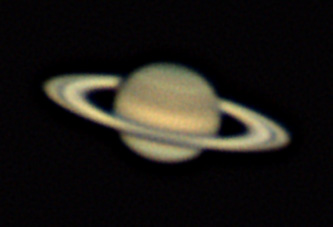

Click to enlarge
Here are a couple of mediocre pictures of Mars and Saturn followed by the best picture of sunspots
I've ever taken, containing the biggest sunspot group I've ever seen.
Mars and Saturn were imaged on the evening of May 10 using my 8-inch telescope and DFK video camera.
Each is a stack of thousands of video frames. Mars is now quite distant — about three times the
minimum distance it reached a few years ago — and it's surprising that we can still record so much
detail. Saturn, of course, is well placed for observation, but when I took these pictures the air wasn't
very steady.
The sunspot picture was taken today (May 11) under what I thought were mediocre conditions.
I used a 5-inch telescope with a Baader solar filter and Canon 40D camera; four 1/1000-second
exposures were stacked. The grain that you see in the picture is mostly the real granulation of the
solar surface, not a camera effect, and you can also see some faculae (bright areas).
The orange color here is artificial; the Baader filter is bluish, so I converted the image to black and
white and then introduced color. I've just received a new Thousand Oaks filter that is orangeish and
will not require this manipulation.
Permanent link to this entry
|
2012
May
7
(Extra)
|
On creating a C# style guide
Many years ago, a famous book
by Kernighan and Plauger opened
my eyes to the importance of style and layout in computer programming.
It's not enough for the program to run correctly;
it must also be written in a way that makes it easy to read and understand.
Since then,
I've been involved in creating programming-language style guides twice:
as lead author of
this style guide for Prolog
(but instead of that, please read the slides here),
and more recently, when trying to create
a brief personal style guide for C#.
Microsoft already publishes widely accepted style guidelines for C#.
I mainly wanted to deal with situations about which they don't have much to say,
such as if statements with very complex Boolean expressions
(common in my kind of work).
The only point on which I really disagree with Microsoft is that I don't like
what they call camelCase (that is, compound words with the first letter lowercase
but the subsequent words capitalized — looking like a camel with its head down).
I prefer either PascalCase (every word capitalized,
the usual C# practice for nearly all names, as it was in the Pascal language) or pure lowercase.
The reason is partly that camelCase looks unnatural, and partly that it looks
too much like PascalCase. If you want a visible distinction, you need more than that.
In Prolog, it is very important whether a word begins with a capital letter or not,
and camelCase looks enough like PascalCase to cause confusion, so we dis-recommend it.
I've carried the same thought over to C#.
Actually, I can almost make it a moot point. Microsoft specifies camelCase only
for local variables and argument names. In my opinion, anything local enough to
fall in those categories shouldn't need a long name. I understand that inputFileNameValidationTest
is easier to read than inputfilenamevalidationtest, but both of those are too long for
the situations where camelCase is actually specified. How about valid or maybe validfn
or at most validfilename?
But here's what surprised me. When I started discussing C# style with friends on online forums,
a surprising number of them felt that (1) Microsoft has already set the standards; (2) it is a sign
of depravity if a person even thinks about violating them.
People who feel that way need to think more deeply. Style guides are a means, not an end.
One of the most important things about style conventions is that they should be bent or broken any
time doing so makes the program more readable and maintainable.
Then there are taboos. The people who most dogmatically tell you never to code a goto statement or a public
field are the people who cannot tell you why.
The same applies to dogmatic taboos in other areas of life.
Permanent link to this entry
|
2012
May
7
|
Sunspots!

I took this picture of the sun
to make sure my equipment is ready for the transit of Venus across the sun's face on June 5.
Celestron 5 (vintage 1980), Baader Mylar filter, and Canon 40D. This is the result of stacking two 1/1000-second
exposures with RegiStax and then sharpening the resulting image with Photoshop.
Canon Live View Shooting was used to eliminate vibration.
The blue color is artificial — the result of the filter — and a more fastidious
photographer might have converted the picture to black-and-white or even tinted it orange.
This is the first time I've photographed the sun digitally.
I really like working that way because my eye is never in the light path;
I'm looking at the camera's LCD screen.
If the filter were to fall off the telescope suddenly,
I'd burn up a camera, not an eye.
The filter is, of course, perfectly safe if used properly, but I always
imagine the worst.
Permanent link to this entry
|
2012
May
6
|
"Supermoon" in super-color
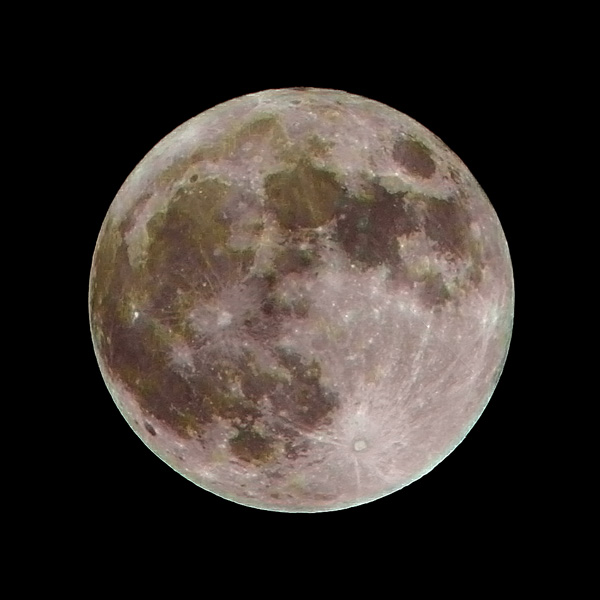
On the night of May 5, Full Moon and lunar perigee coincided; that is, the full moon
was about as close to the earth as it can get. This made it 14% larger and 30% brighter
than its minimum. The newspapers were promoting this as a "supermoon." In fact, something
similar happens every year. But here it is. The colors have been enhanced so that you
can see subtle differences between different minerals on the moon.
I didn't set up a telescope for this one. I used my Canon 40D DSLR with a Canon 300-mm lens
and ×1.4 converter, giving 420 mm. What you see is a stack of two exposures
(to reduce camera noise). The weakest link in the optical system was actually the air,
which introduced some chromatic aberration; in RegiStax, I shifted the red image up one pixel
relative to blue and green to correct the problem. Then I used Photoshop to sharpen the
image and raise the color saturation.
Permanent link to this entry
|
2012
May
5
|
On the source of the Fallacy of Sunk Costs
A common type of bad management decision is known as the
Fallacy of Sunk Costs.
Basically, it amounts to saying, "This was costly, so we must stick to it
even if something cheaper and better is available now."
Sometimes it amounts to "throwing good money after bad" (continuing to invest
in a losing proposition). Often it means keeping a piece of equipment or practice
after it becomes obsolete. Sometimes it means being determined to reuse something
when it would be cheaper and better to recycle the raw materials and make a new one from scratch.
And a famous example from one of Mankiw's textbooks is
feeling that you must go to a concert because you paid $120 for a ticket,
when actually, you never promised to go to the concert; you just paid $120 for the option of going,
and something could perfectly well come along that is a better use of your time.
Why do people make this kind of mistake?
Partly, as many people observe, we have a natural bias to stick with what we've started,
and that keeps us from being fickle.
If you can't be sure, moment by moment, whether you're heading in the right direction with something,
it's better not to change course too often. Changing courses introduces costs and risks of its own.
But the other day I was thinking about it, and a more important reason for the Fallacy of Sunk Costs
hit me.
People feel insulted if you don't use the products of their work.
If you sink costs into something that involves direct interaction with a human being,
that human being is going to feel unappreciated if you choose, at the last minute, not
to use what you bought.
Suppose, instead of buying a concert ticket, Mankiw's example person had actually hired
a musician to come and play privately.
That musician would feel insulted if the performance were cancelled at the last minute
without a compelling reason — even if this didn't impact his pay.
I think the answer is for people to understand that such decisions are not insults.
Consider the cancellation of a project in a high-technology company.
Good management generally involves pursuing a project with full energy until the moment
comes when it's not the right thing to do, and then cancelling it suddenly.
(This is like selling an investment ruthlessly when its value stops going up.)
The people working on that project are likely to feel unappreciated even if they
are well paid for their labors.
Unless they understand the logic of the decision,
they will think management is wasting their work product.
And that, I think, is one of the flaws in the Soviet-style "planned economy."
It assumed you could bring fulfillment to workers by assuring them they would
always have jobs doing the same things, or at least that all changes could be foreseen
well in advance. That is why, in the USSR, it was always 1930.
Permanent link to this entry
The inflation-housing conundrum
One surprising thing about the economic recovery has been that various efforts to
expand the money supply (low interest rates, "quantitative easing," etc.) have
not produced inflation. People have been reducing their indebtedness instead of
increasing their spending. That means the Fed has not had to raise interest rates
to curb inflation.
One thing was bothering me about this. Real estate prices are included in the
measure of inflation. (Why not? Housing is part of the cost of living.)
So are we looking at an illusory lack of inflation in which housing costs
have plummeted while everything else might be inflating right along?
And in particular, if the promised "real estate recovery" were to happen suddenly,
wouldn't it amount to sudden inflation (of housing prices), prompting changes
in monetary policy?
What I now think is that the real estate recovery isn't coming.
See Shiller's data here,
continuing something I remarked on a few years ago.
The "bubble" was a one-time thing, and house prices are now close to their
long-term stable level. Of course, existing houses can rise in value even when the
overall price level isn't rising, because a particular location can become more
built up and desirable — or, especially in the de-industrializing Northeast,
the opposite can happen! Who wants to move to Rochester, New York, right now?
I'll bet the students at the Eastman School of Music are getting some real
bargains on places to live.
There is still a bit of circularity; part of the reason long-term housing prices
are stable (inflation-adjusted) is that housing prices are part of the inflation adjustment.
But only part of it.
Permanent link to this entry
What's up in the sky
Jeff Duntemann
summarizes what's going on.
Tonight (May 5) the full moon will be a few percent larger in diameter than normal because it's
closer to the earth. (The preceding and following nights are about the same.)
Something like this happens every year; don't expect a spectacle. Then, in two weeks, the
western U.S. gets an eclipse of the sun, and on June 5, Venus passes in front of the sun
(a tiny spot visible only with a telescope; if you look at the sun, make sure you know how
to do it safely!).
Permanent link to this entry
|
2012
May
1-4
|
The Bay of Rainbows in black and white

Despite its fanciful name, the Bay of Rainbows (Sinus Iridum) on the Moon
is not a colorful place. At most, there are slight variations in the color
of the lunar soil.
Unfortunately, this picture does not show them.
I took it with a DFK color video camera and 5-inch telescope, stacking and
combining thousands of video frames in the usual way to overcome undulations
in the air that would blur the image.
Alas, I chose the wrong video codec and ended up with a black-and-white
recording.
Still, this is better than nothing.
Permanent link to this entry
Spreading malicious gossip is wrong
(even in an election year)
(The regular readers of this Notebook do not need this advice, but I'm
putting it here so that people will find it through search engines, and also
to suggest to my regular readers some ways of explaining this important
moral principle to others.)
Did you hear that members of Congress can retire with a $174,000 salary
for life? Or that President and Mrs. Obama both lost their licenses to
practice law?
Those would be shocking news items except for one thing — they're not true.
Yet each of them has been sent to me many times through Facebook, e-mail, and online forums.
Most people would claim to know that spreading malicious gossip is wrong.
But that's exactly what you're doing if you pass along "information" like this.
Somebody is spreading it in order to harm someone else,
perhaps politically, perhaps some other way.
This kind of malicious "information" reaches you from a friend.
No real source is mentioned; sometimes the message mentions CNN, a newspaper,
the FBI, or the IRS, but there is never a web address where you can actually
see the source.
The hallmark of a malicious message is that it says
to "pass it on" or "copy and repost."
In my experience, that's PROOF that it's false.
In my 31 years on the Internet, not once has an accurate message
arrived "passed along" by a friend (not the original author)
with an exhortation to "spread the word."
Not once.
True information has an author — someone who will take responsibility for it —
and can be confirmed by looking at authoritative web sites.
One particularly handy place for checking out rumors is www.snopes.com,
which is very reliable. Or you can just Google the juicy item and see what other people have to say.
If you pass these things along without checking them out,
you don't know who is using you.
For all you know, you might be passing along al-Qaeda's or Kim Jong-Un's propaganda.
More likely, people are just laughing at you.
And besides that,
nobody loves a gossiper.
Permanent link to this entry
|
|
|
This is a private web page,
not hosted or sponsored by the University of Georgia.
Copyright 2012 Michael A. Covington.
Caching by search engines is permitted.
To go to the latest entry every day, bookmark
http://www.covingtoninnovations.com/michael/blog/Default.asp
and if you get the previous month, tell your browser to refresh.
Entries are most often uploaded around 0000 UT on the date given, which is the previous
evening in the United States. When I'm busy, entries are generally shorter and are
uploaded as much as a whole day in advance.
Minor corrections are often uploaded the following day. If you see a minor error,
please look again a day later to see if it has been corrected.
In compliance with U.S. FTC guidelines,
I am glad to point out that unless explicitly
indicated, I do not receive payments, free merchandise, or other remuneration
for reviewing or mentioning products on this web site.
I have a Canon EOS 20Da camera and a Tektronix
TDS 210A oscilloscope on long-term loan from their manufacturers. Other reviewed
products are usually things I purchased for my own use, or occasionally items
lent to me briefly by manufacturers and described as such.
I am an Amazon Associate, and almost all of my links to Amazon.com pay me a commission
if you make a purchase. This of course does not determine which items I recommend, since
I can get a commission on anything they sell.
|
|