|
|
|
| |
|
2013
June
28-30
|
Vote with your mouse
(Don't click on trashy news stories; you're being watched!)
The Internet has brought a big change to the way newspapers work.
When a newspaper is on line, the publisher knows exactly how many
people have clicked on each story.
This is influencing journalism in what I think is a bad way.
We're getting less substantial news and more celebrity gossip,
"wardrobe malfunctions," etc., even in dignified major newspapers.
It's obvious why. More people will click on "Actress in skimpy swimsuit"
than on "New immigration bill before Congress." Even if they think it's
trashy, they'll click on it just to see what it is.
And that drives the newspaper to — as Shakespeare would say —
play to the groundlings.
Related to this, here is a safety warning
for all web sites, not just newspapers:
Don't click on any link that says "You won't believe this" or "This is
amazing," or words to that effect, but doesn't tell you what "this" is.
Those are very likely to be scams and malware.
Some go as far as to show a person's face and say, "Click to see what
she is saying about you." Those are just empty words, of course; "she"
isn't real and isn't saying anything about you.
Permanent link to this entry

|
2013
June
26-27
|
Typing foreign characters and special symbols in Windows
Does anybody remember Character Map from Windows 3.1? It's still there...
and now that Windows supports full Unicode, it gives you access to a huge
range of foreign-language characters and mathematical symbols, which are
copied to the Clipboard for you to paste into any application.
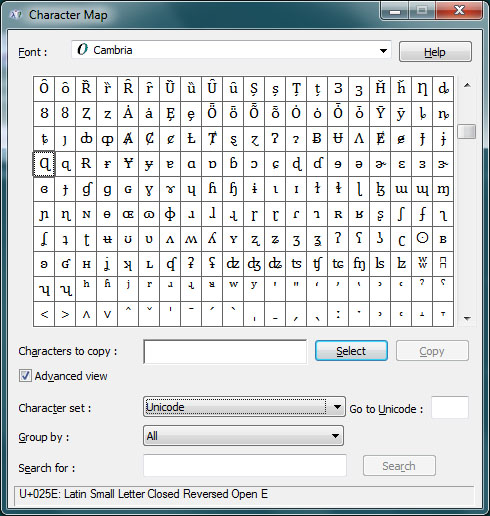
To get to it, try Start, All Programs, Accessories, System Tools, Character Map.
If you use it much, you'll want to make a shortcut to it.
This is one of many ways to type foreign languages in Windows.
You can also adopt a foreign keyboard layout
(such as US-International, very handy)
or "Insert Symbol" in Word.
Permanent link to this entry
|
2013
June
25
|
Free silver from banks?
You may have heard a long-winded radio commercial that directs you to a
long-winded web site that promises to tell you (eventually!) how to
get silver, "free," from any bank, even without opening a bank
account.
I am glad to be able to reveal their secret.
What you're supposed to do is
convert a lot of cash into half dollars
and then pick out the ones that are dated 1969 or earlier.
The half dollar circulates a lot less than our other coins, so later dates
have not driven the older ones out of circulation (such as it is);
in fact, production of half dollars for general circulation has effectively been
discontinued.
Thus, your chances of getting half dollars from the 1960s are still reasonably good.
And half dollars contained some silver until 1969.
Dimes and quarters were made of silver until 1964, but they circulate so
much more that almost all of the old ones have been withdrawn by now.
So that's the secret. How lucrative such a scheme might be, I don't know.
I'd think that if it were worthwhile, the banks themselves would be doing it.
Permanent link to this entry
|
2013
June
24
|
Wayne Grudem, Business for the Glory of God
A while back I wrote a review
of Catholic philosopher Michael Novak's
Business as a Calling.
Now let's let a Protestant systematic theologian weigh in.
The book I'm reviewing is Wayne Grudem's
Business to the Glory of God,
a short book based on a conference presentation.
If you're expecting a knock-down drag-out defense of the "Protestant work ethic," think again.
That's something that may never have had defenders per se, only critics.
Grudem's book is much better described as things economists and careful Bible-readers know,
but about which many Christians have misconceptions.
It's short but balanced.
Many Christians have been led to feel that property, profit, employment, lending, and
competition are vaguely evil and exploitative and are things God only tolerates
reluctantly. (Personally, I think this may be because so many church leaders soaked up
popular Marxism during the Great Depression, when Marxism wasn't stigmatized as un-American,
and we are still hearing their echoes.) By contrast, Grudem points out the element of
mutual benefit in nearly all economic activities. Certainly, everything can be
misused, but misuse is not normal, and the possibility of misuse does not make something evil.
"When the employer/employee arrangement is working properly, both parties benefit.
This allows love for the other person to manifest itself" (p. 33). Grudem goes on to
argue that both parties end up better off than if they had not entered into
the relationship. This is, of course, something economists understand, and it contrasts
sharply with the Marxist doctrine that the employer is stealing some of the fruits of the
worker's labor. Likewise, Grudem argues (with all mainstream economists, against Marxism)
that profit is a legitimate way to be paid not only for managing activities, but also for
taking risks that others are unwilling to take.
Grudem also points out, particularly at the beginning, that economic activity lets us
glorify God by sharing in His activities. J. R. R. Tolkien made much of the fact
that a novelist, creating his own world, tastes what it was like for God to be the Creator.
In the same way, argues Grudem (without mentioning Tolkien), simply owning possessions gives
us a taste of God's sovereignty; productive activity lets us participate in God's creating
and sustaining the world; and so on. We have instinctive desires to do these things because
God made us like Himself.
The chapter on borrowing and lending provides a welcome counterbalance to the "debt-free living"
imperative that seems to be sweeping through evangelical Christendom. Very simply, the
Bible does not say lending is wrong; it says lending is productive, and Jesus even advises
people to lend at interest (in the Parable of the Talents) — not to poor people who
would be exploited, but to capitalists who can use the money more productively.
Grudem points out that recently, America and Europe have had a problem with excessive
personal borrowing, but that doesn't mean borrowing is evil. On the contrary, borrowing
and lending make property (including money) much more useful. And of course, as most of us
know but some need to be reminded, the Bible verse translated "Owe no one anything" does
not mean "never borrow" — it means "don't refuse to pay your bills," as the context
makes clear.
The chapter that will raise the most eyebrows is about unequal distribution of income.
Grudem argues forcefully that while poverty is evil, inequality is not.
God never seems to have set out to make everyone equal in the first place. The Bible
says plenty about differing responsibilities and differing rewards. Grudem gives what
is essentially Mirrlees' argument that if individuals differ in
ability and opportunity, but we want them all to have incentives, then unequal rewards
are necessary. (One might also add that not everyone wants to do
the same amount of work — so there!)
Grudem even points out that while the Bible often says to give to the poor, it never says
to take from the rich. The notion that great wealth (and great responsibility) can only
be held by governments or companies, not individuals, is a modern peculiarity. Naturally,
the rich are extremely accountable for what they do, but the point is that no one else
is ever commanded or authorized to take their wealth away.
The final chapter argues, briefly but convincingly, that business is the solution
to world poverty. In the long run, it is the only thing that can lift people out of poverty.
Surprisingly small amounts of assistance, including microloans, can have a large impact if
they are directed at helping people set up enterprises. All too often, a country is
poor because its government interferes substantially with people's attempts to run
businesses — either out of simple ineptitude (failing to provide a safe, stable
environment), or corruption, or the blurry Marxist notion that private enterprise should
be prohibited.
Permanent link to this entry
|
2013
June
19-23
|
UFOs and other things
As you might guess, I'm keeping busy writing things other than Notebook entries.
But here are a few short notes...
Recently, several people have asked me about unidentified flying objects or, more
precisely, unidentified lights in the sky. There may be pranksters in Middle Georgia launching
flares on balloons, or something. Apart from that, I'm always glad to bring to bear any
astronomical knowledge that might help identify mysterious objects.
In retrospect, though, I think it was very strange that people in the 1950s decided that
unidentified things in the sky must be alien spacecraft, and the idea stuck.
Click here for my take on UFOs.
There are so many other things they could be — including undiscovered things.
In fact, when I first started reading about UFOs as a child, I was immediately skeptical
about space aliens but hopeful that UFOlogists might discover new atmospheric or astronomical
phenomena, or even optical illusions.
After all, how much other evidence do we have for space aliens? None at all!
Permanent link to this entry
So you're thinking of visiting a church?
If you're thinking of visiting any kind of Christian church
(urban or rural, Protestant, Catholic, or Orthodox),
you might want to read this.
I finally got around to writing it.
The inspiration was the book How
to Be a Perfect Stranger,
by Matlins and Magida, which — in its first edition, years ago — was
little more than a collection of raw data obtained by surveying people.
I felt the part that covered Christianity (which was the bulk of the book)
could be digested down to a couple of pages.
And I finally did it.
Permanent link to this entry
|
2013
June
18
|
Three farewells
We bid farewell and requiescant in pace to three people this week:
Jean DeLoach, a long-time family friend in Valdosta, one of my mother's close
friends at the time I was born;
Patsy Smith, legendary Valdosta art teacher, whom I had for sixth grade art
and again briefly in high school (at VHS) before I joined the debate team and had to
change my schedule;
Charles Hudson, author of The Southeastern Indians, whose anthropology
course I very much enjoyed as a UGA undergraduate.
Permanent link to this entry
|
2013
June
16-17
|
What are tensors?
Mathematics day in the Daily Notebook...
The latest wave of AI algorithms "use tensors," which has led me to object to the
ambiguous way mathematicians use the word "tensor." I've seen the word used to mean 3 different things:
(1) An n-dimensional array of numbers, where n (the "rank") is 0 (scalar),
1 (vector), 2 (matrix), or higher.
(2) Like (1), but implying that n > 2, or else it would be called a
matrix, a vector, or a scalar.
(3) A tensor as defined in (1) understood as a transformation applied to a tensor
of lower rank. Thus a matrix is a transformation applied to vectors; a tensor of
rank 3 can transform matrices; and so on.
I think (3) may have been the origin of the term. The quintessential example is
the stress tensor in physics. The stress on a solid object is a transformation of
3-element vectors. If you are at any point in an object under stress, you can
look in any direction (a 3-element vector) and there is a stress applicable to
the direction you're looking; you can think of it as distorting the vector.
The stress tensor is in fact a matrix, a tensor in sense (1) but not (2).
I know (1), (2), and (3) are closely related, but they still reflect different
ways of understanding tensors from the human point of view. It's annoying to get ready to
sink my mental teeth into (2) and then find someone is merely doing (3) with a matrix,
using familiar linear algebra.
Permanent link to this entry
|
2013
June
15
|
New hat
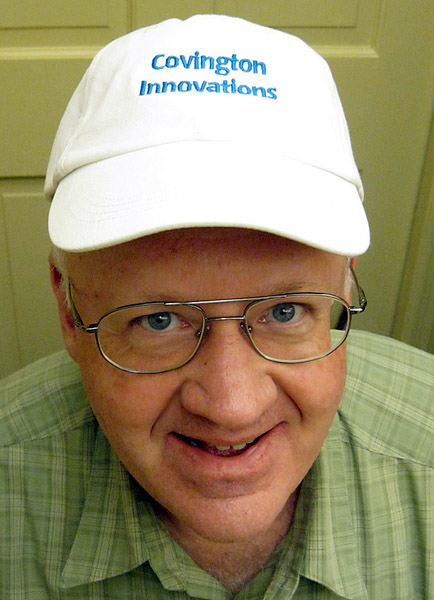
I am literally wearing a new hat these days; the consulting business
is going well. (Photo by Melody.)
So far only one had has been made; there may be a few more,
but I'm not planning a mass giveaway.
Vistaprint made it, quite
affordably, from a bitmap image.
There may also be a Covington Innovations coffee cup in the future.
Permanent link to this entry
|
2013
June
14
|
Do we really want a totally free market for labor?
I recently expressed agreement with
this court decision,
which ruled that many unpaid internships are a violation of minimum-wage laws.
During the tight labor market of recent years, some companies have been availing
themselves of "interns" as a source of free labor, not just recipients of education.
The court wants to restrict that.
I was surprised to get several replies from people who think we shouldn't have
minimum-wage laws (nor, presumably, other wage-and-hour laws or industrial safety
laws). Sink or swim, they say. Setting a minimum wage just causes unemployment.
Well... I know a minimum wage causes a certain amount of unemployment. If the minimum wage
is $6 per hour and you can't bring somebody $6 per hour of profit, you can't have a job.
The thing is, without a minimum wage, you wouldn't have a job you could live on, either,
and neither would other people. The minimum wage forces employers to manage labor in such a
way that it is reasonably profitable. It prevents a tradition from arising of paying people
far less than a minimum wage and making them work in degrading conditions.
But won't the free market take care of that? If a job isn't tolerable, won't people
just refuse to take it?
I reply: Those who cannot remember the past are doomed to repeat it, and I'm afraid
the current vogue for libertarianism, combined with ignorance of what has historically gone
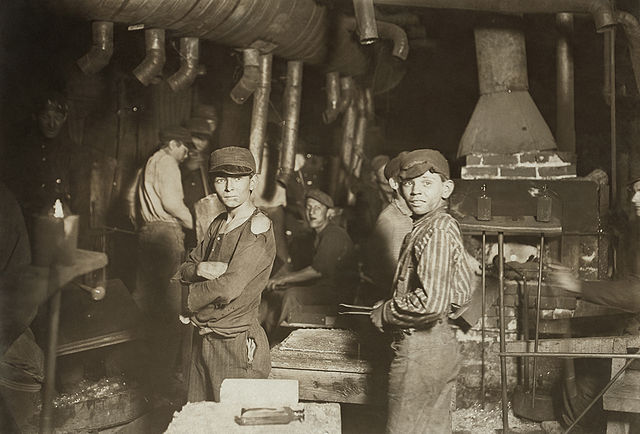
wrong, may take us back to the bad old days. (Like the photo by Lewis Hine above,
of child laborers in 1908.)
Free markets are a great way to allocate resources, but they're not perfect.
They fail when power is very unevenly distributed.
For example, in The Grapes of Wrath we read a
realistic account of people who gave up farming during the Great Depression
to try to be migrant farm workers. Employers could easily make misleading offers,
and the workers couldn't communicate among each other to find out how bad the
situation really was. The free market failed to work as intended.
Labor unions were one early response to this kind of market failures.
Modern means of communication are another.
Anybody who wants to apply Christian values to economics also needs to know
about Rerum Novarum, the famous encyclical in which
Pope Leo XIII, assisted by top-notch Catholic economists, denounced both Communism and a naive form
of capitalism. His point: Saying "we have a free market" or "they're doing everything voluntarily"
doesn't exempt you from responsibility for the way you treat people. Workers have responsibilities
to do an honest day's work, refrain from rioting and vandalism, etc.; employers have a duty to pay a
living wage, have reasonable work expectations, and generally be aware of what they're doing to people.
Even if you disagree with the details (and if you're not Catholic, Rerum Novarum certainly
does not bind you as authoritative), this is something you need to know about. It is not left-wing drivel.
An important sequel to it was written by John Paul II, the man who brought down Communism.
Finally: If you claim to be a Christian but get your moral philosophy from Ayn Rand,
get out of my face. Rand is one of the most vehement enemies Christendom ever had,
and it's bizarre that so many of my fellow Christians have been bamboozled into thinking
that Christianity equals extreme capitalism equals Rand.
Permanent link to this entry
|
2013
June
11-13
|
NAACL-2013
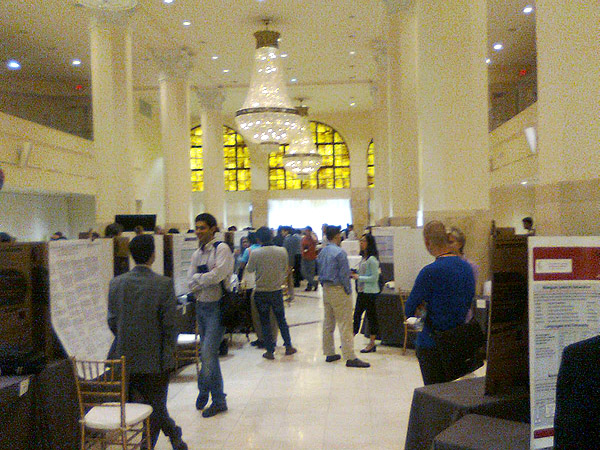
On Monday (June 10) I attended one day of the North American meeting of the
Association for Computational Linguistics (NAACL-2013;
proceedings here and
here.
I hadn't been to an ACL meeting since about 1998. I had a delightful time
reconnecting with colleagues. There was a lot of talk about the "Covington parser,"
which is actually (I think) one of Joakim Nivre's dependency parsers based on a
paper of mine from years ago. I'm better known than I thought.
Also vindicated: in the late 1980s everybody was telling me dependency parsing was worthless,
and nowadays everybody is doing it.
The meeting was in the Westin Hotel in Atlanta.
As you see in the picture, the poster session was held at 200 Peachtree, formerly
the Davison's department store in downtown Atlanta, where Melody was occasionally
taken shopping as a child. Also, while in the neighborhood I located the place
where I bought my Olympus OM-1 camera in 1976. Foto-Crafts-Atlanta was at 135
Carnegie Way, which is now a Courtyard by Marriott hotel. That's Atlanta: you
identify a place by what is there now, what was there ten years earlier, what else
was there ten years before that...
Permanent link to this entry
|
2013
June
10
|
Against cloud computing?
I don't quite trust the "cloud computing" vogue,
and Richard M. Stallman, free-software radical, has now expressed
a position like my own, but stronger.
Key idea: Cloud computing threatens to make us dependent on just a few,
expensive, centrally controlled services, which is the opposite of what
microcomputing and the Internet have been doing for us until now.
Back around 1972, just before microprocessors were invented, a lot of us imagined
a future worldwide mainframe computing service, with terminals in every home and
office. Naturally, we expected it to be centrally controlled.
(Control Data's CYBERNET scientific computing service foreshadowed this and
was really useful to its subscribers.)
Microchips came along and changed all that. By 1982, you could have a
reasonably powerful computer that ran all by itself, without dependence
on a mainframe service provider.
Meanwhile, the Defense Department's high-reliability network technology
became the Internet, crucially with no central control point — it
is basically a peer-to-peer network throughout, with all control and relaying
functions shared among computers owned by anybody and everybody.
That's right — nobody controls the Internet.
That's what made it the most powerful force for freedom since the printing press.
Enter, now, cloud computing. Instead of letting your computer run by itself
and store its own data, you're supposed to rely constantly on
one or more central service providers.
While this is useful in some ways, it also threatens to take us back to the
bad old days, when there were central control points, central points of failure,
and central companies to whom money had to be paid.
Fifteen years ago, web hosting and e-mail were handled by thousands of different
independent ISPs. Today I am starting to meet people who think all e-mail
should be on Gmail.com and all files should be on Google Docs or Dropbox...
in short, they want just a few near-monopolies instead of the radically
decentralized network we used to have.
This is not good. Perhaps the strongest force toward centralization comes from
search engines such as Google and Bing. The world can only support a few of them
because of economies of scale (they benefit greatly from being huge),
yet everybody needs them. Could we reinvent
search engines to work more like the Domain Name System, based on sharing
information between vast numbers of voluntarily participating machines? Just a thought...
maybe a way to reduce the pressure toward central control.
My own approach to cloud computing is mixed. I have my own e-mail and web domain
(covingtoninnovations.com), hosted by an ISP in Michigan (and formerly
hosted somewhere else; I can move it whenever I want to). I use Dropbox for a
few unimportant things, but mostly I do cloud computing on my own server
so that I can sync my laptops, from anywhere, to a computer in my own house.
Let's reverse the trend of turning computing into cable TV, which seems to be
the direction in which we're headed. Remember when you could get TV without
paying for a cable subscription? No? It was done with antennas...
Permanent link to this entry
|
2013
June
7-9
|
Data mining — a term being hijacked?
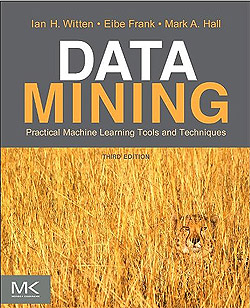 I fear that the news media are hijacking the name of one of the things I do professionally.
They are using the phrase "data mining" to mean "unauthorized snooping."
That's not what data mining is.
Data mining is the use of computers to search for patterns in data.
It's very valuable.
Nobody objects when a grocery store data-mines its own sales data to find
out which products are often bought together, or when a telephone company
data-mines its traffic data to figure out where to build more lines.
(Click on the picture for a good book about data mining.)
When telephone traffic records go to the federal government,
the controversial thing isn't data mining — it's who's getting whose data.
Please, let's not use the term "data mining" to mean unauthorized disclosure
of data to a third party.
Permanent link to this entry
Telephone follies
For decades I have answered the telephone with the words, "This is Michael Covington,
may I help you?"
Increasingly, callers are unable to understand a word of that.
It is as if I had said, "Εδώ είναι ο Michael Covington. Πώς μπορώ να σας βοηθήσω?"
All they want is "Hello." They don't understand anything else.
The other things they don't understand are, "Who is calling?" and "To whom do you
wish to speak?"
(I know using "whom" is like speaking Latin these days, but I persist in it.
I figure that if you call me, you ought to understand my language.)
Lately I've had a couple of calls for "Who dat?" and one who only said,
"Don't call me 'bout no break-in!" Neither of them had a clue who I was.
Permanent link to this entry
|
2013
June
4-6
|
When ink spreads out on the nib of a fountain pen
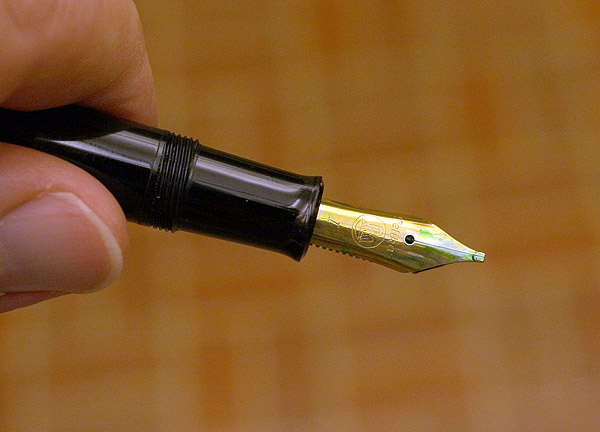
Some of my fountain pens have a tendency to get ink all over the metal surface
of the nib. This could be caused by rubbing the nib against the cap as you take
the cap off, but I checked carefully to make sure that wasn't happening.
On most pens, it is not actually a problem; the ink doesn't get on the cap or
your fingers, unless it's a Sheaffer "inlaid" nib, which doesn't have a grip
separate from the nib itself. Anyhow it looks messy.
After investigating the problem at some length, I've found that it's much worse
with some pens than others; some nibs may have a very light coating of wax (which might
need restoring) to make the surface repel watery solutions; but mainly, it's the ink.
In particular, it's the amount of wetting agent (detergent) in the ink. You may
sometimes notice that an ink has a tendency to foam if the bottle is shaken before
you take the lid off, or if a pen sends bubbles of air through it. That's an
indication of lots of detergent.
I have the worst problem with a relatively new Hunter ink; the least, with Sheaffer blue
and Waterman blue; several reds or purples are in between.
So, among other things, the bottom line is, with Sheaffer inlaid nibs, use Sheaffer ink.
And with everything else, keep your eyes open!
Permanent link to this entry
|
2013
June
2-3
|
Point of theology
Young-earth creationists often assert that God created the earth recently but
with the appearance of age, which includes
false evidence of
numerous past events that didn't happen,
from supernovae to the life and death of particular animals.
A fellow Christian whose judgement I respect points out that
this distorts the character of God much more than a mistake about
morality or ecclesiology would.
If God is a deliberate deceiver, what does that tell us about His integrity
and about the nature of revelation?
You've almost moved out of monotheism as we know it.
You'd be worshipping a trickster god like Loki whom you can't trust at all.
This is perhaps the biggest reason I'm not a young-earth creationist.
If someone were to show that the earth is, after all, young, they would have
to account for all the evidence that it apparently is old.
And by "account" I do not mean "just say God tricked us."
Permanent link to this entry
Short economic notes
Has anyone noticed that interest rates are starting to go up?
Not the prime rate, but various bond rates and loan rates.
Back in the 1970s we were being told that the "population explosion" would lead
to mass starvation within our lifetimes.
Actually, world
poverty is being conquered,
and it's due to economic development. Whether or not you accept all the explanations
offered in that particular article, the fact remains that poverty is diminishing.
This leads to three more remarks:
(1) The United States is no longer the only big prosperous nation, and the people who still
think it ought to be need a reality check.
(2) One reason gasoline is expensive is that more people around the world want to buy it.
(3) Pollution and carbon footprint are largely developing-nation problems, not North American and western European problems.
China and India are a lot more populous than the U.S. and will soon be much larger energy consumers,
if they aren't already.
Permanent link to this entry
|
2013
June
1
|
An affordable laptop for college
A friend asked me how to find an affordable laptop computer for his
daughter to take to college, and that led me to jot down a few notes here.
I'm sure not everybody will agree with everything, but here's how I see it.
This advice is for students who are not computer experts and do not
have specialized needs.
You don't have to buy one machine for four years.
For a student whose computer needs are unclear or uncertain,
consider buying the cheapest usable machine, maybe secondhand or
handed down from another family member, and making another purchase
one or two years later. If you try to buy a computer that will
be up-to-date four years from now, it will be overpriced today.
Don't buy too much before you know what you need.
PC, not Macintosh. Let's face it, Macs are like BMWs —
well-built but expensive — and you're looking
for a Chevy. Besides, Macs don't run PC software. Don't assume that you
have to have a Mac just because you're doing art or music or because the
college bookstore pushes Macs (and makes a big profit on them).
And if you've been frightened away from PCs ("only a Mac is easy to use"),
overcome your fear and get back to reality. If Windows were unusable, 95% of
the world's computer users wouldn't be using it. And you don't want to come
out of college unable to use it, do you?
My experience is that Asus laptops are very similar to Apple Macbooks in
construction and quality, but they only cost half as much because they run Windows.
I also like Lenovo and Dell.
Don't mix up Asus with Acer, which is low-priced and, in my limited
experience, not as solidly built as the competitors.
You don't need high-end graphics. The difference between a $400 laptop
and a $700 laptop is likely to be an ATI or NVIDIA graphics system, needed for
interactive game playing but not, in my experience, needed for anything else,
not even photo and video editing. Similarly, you don't need an enormous disk drive.
You don't have to buy Microsoft Office. If you do buy it, get the
student edition. In fact, look for student editions of other expensive software,
such as Adobe products, through your college bookstore or
JourneyEd. The discounts are
often enormous. But you can use free software such as OpenOffice
for practically all of your work.
Be skeptical of the college bookstore. As I said, student prices on software
are often excellent. But "student discounts" on computers themselves (laptop or desktop)
probably won't undercut Wal-Mart, Office Depot, or Micro Center. Shop where working
people shop. Find out what kind of laptops the faculty of the college are using.
Finally: I have mixed feelings about used laptops. Laptops tend to get
beaten up and worn out within just a few years. Having said that, a good used
laptop with at least Windows Vista on it can be a bargain. Batteries need replacing
after a few years; keyboards and disk drives are easy to replace too, and I have
routinely done this on older laptops that I'm using myself.
Permanent link to this entry
It's a book
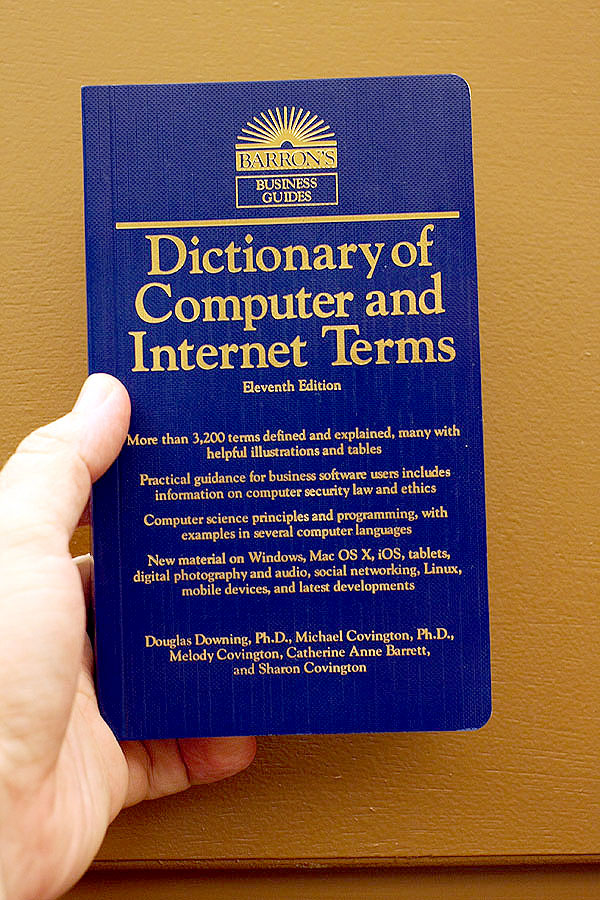
Our latest book is the eleventh edition of this classic, and now it has five
authors. Click on the picture for more information.
Permanent link to this entry
|
|
|
This is a private web page,
not hosted or sponsored by the University of Georgia.
Copyright 2013 Michael A. Covington.
Caching by search engines is permitted.
To go to the latest entry every day, bookmark
http://www.covingtoninnovations.com/michael/blog/Default.asp
and if you get the previous month, tell your browser to refresh.
Entries are most often uploaded around 0000 UT on the date given, which is the previous
evening in the United States. When I'm busy, entries are generally shorter and are
uploaded as much as a whole day in advance.
Minor corrections are often uploaded the following day. If you see a minor error,
please look again a day later to see if it has been corrected.
In compliance with U.S. FTC guidelines,
I am glad to point out that unless explicitly
indicated, I do not receive substantial payments, free merchandise, or other remuneration
for reviewing or mentioning products on this web site.
Any remuneration valued at more than about $10 will always be mentioned here,
and in any case my writing about products and dealers is always truthful.
I have a Tektronix
TDS 210A oscilloscope on long-term loan from the manufacturer. Other reviewed
products are usually things I purchased for my own use, or occasionally items
lent to me briefly by manufacturers and described as such.
I am an Amazon Associate, and almost all of my links to Amazon.com pay me a commission
if you make a purchase. This of course does not determine which items I recommend, since
I can get a commission on anything they sell.
|
|