2026
March
29
|
Cloud
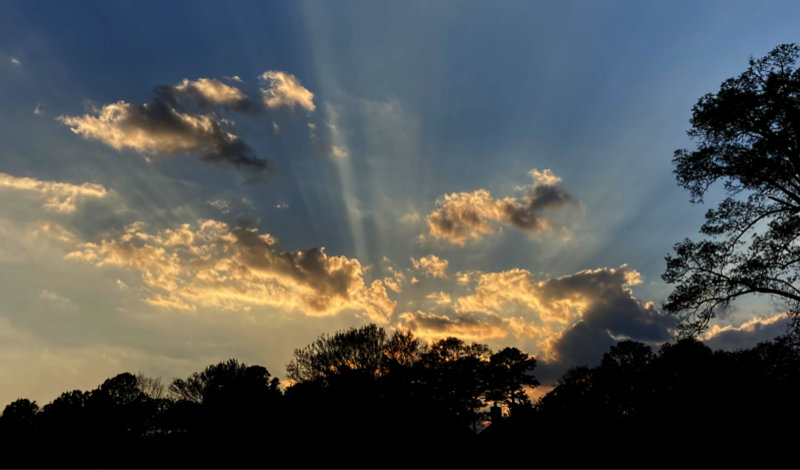
Snapped with my iPhone as I walked around the neighborhood 2 evenings ago.
Permanent link to this entry
Jupiter
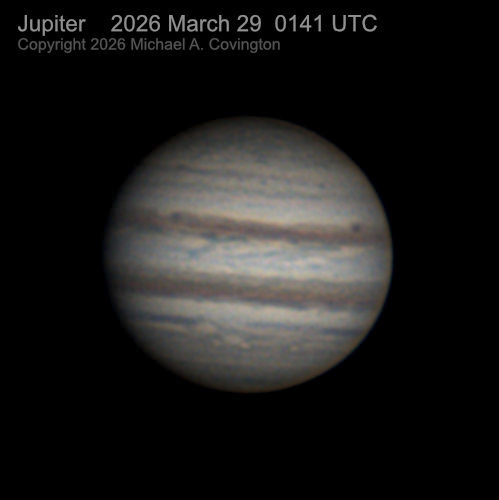
Not the best picture of Jupiter that I've ever taken, but an acceptable record of the
state of Jupiter's constantly-changing stripes at that date and time.
Taken in very unsteady air with my Celestron 8 EdgeHD and ToupTek 678 camera.
For the first time in months, the telescope was riding on my Celestron AVX mount
(vintage 2014) rather than my newer Losmandy; my goal was to make sure the AVX was
still working well, which it was.
I processed this picture with AutoStakkert and then
LuckyStackWorker rather than RegiStax or PixInsight.
All of these sharpen the stacked image by exploiting the fact that the sum of a large number of
random blurs is a predictable type of blur, which can be undone, giving superresolution.
Until now, they've used wavelet deconvolution, which is ideal for undoing a Gaussian blur.
LuckyStackWorker, however, deconvolves a point-spread function that includes the
diffraction of the telescope.
That gives better results and is much less prone to a "rind"
artifact on the edges of planets.
More importantly, LuckyStackWorker saves me a lot of time. It seems to default to reasonable
settings in the first place, and then I can adjust them. Then, wonder of wonders, it remembers
the settings when I process another image of the same object, which makes it easy to get
uniform results (naturally, I can adjust at any time). Also, it runs very fast.
Though I haven't explored all its features, I recommend it.
Permanent link to this entry


|
2026
March
26
|
Exile...
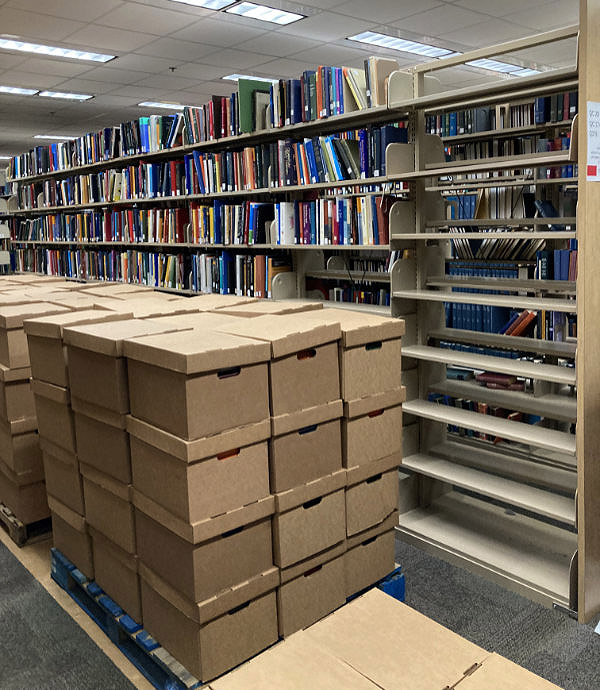
Here you see more of my old friends being sent into exile.
A few years ago, UGA moved many of the older books out of the Science Library and put them in the
off-campus repository. Now they are moving more. I don't know the exact criteria.
I can't really argue with them, but I've been accustomed to seeing these books on the shelves,
and using some of them, for a very long time.
Permanent link to this entry
State of the art
I had several kinds of consulting, writing, and speaking work come up at the same time,
so the Daily Notebook has gotten quiet lately.
Let me just point out a few of the things I'm thinking about:
- Although AI has widely been used as an excuse when businesses want to downsize,
AI is not actually taking very many people's jobs. Studies are showing that agentive AI can
be surprisingly inaccurate. The focus is moving toward having AI help workers with specific tasks,
and also inventing the management model that will make agentive AI work better.
- AI safety is a harder problem that people first thought, because the required safety
mechanisms do not necessarily exist. Suppose, for example, that you want to guarantee that
a chatbot will never tell people to commit suicide. Well, it is easy to make that less likely
with post-training, and by using a second AI system as a guardrail, but can you guarantee
that it won't happen? Only if the output of your AI can be fed to a second AI that is a perfect
natural language understander, much better than the first one. And if you had that, you wouldn't
be using the first one at all. See the problem?
There's much to consider. I'm giving two talks this month on "How society will get used to generative AI."
If you'd like me to speak about this or a related topic to your organization or group, drop me a line.
Permanent link to this entry
Patent and copyright updates
Yesterday I went to a presentation at UGA by attorneys from the law firm
Womble Bond Dickinson
about recent developments in patent and copyright law. High points, as best
I understood them:
- The current director of the USPTO has been taking steps, in just the past few months,
to make it easier to patent software-related inventions.
The invention must still make a machine do something, not just deduce a result,
so that it is more than a mental process.
- You can register a copyright on source code that contains trade secrets without revealing the trade
secrets. There are several ways to deposit a sample or a redacted copy of the source code
rather than the whole thing.
- Although you don't have to register a copyright for it to be valid, it pays to do so,
because then, if there is inringement, you can collect statutory damages rather than having
to show how much the infringement cost you. This can be crucial if the thing copied was
something you had not yet made much money from yet, or something that is not used by itself.
Registration only costs $45 for a book or pamphlet, slightly more for other kinds of material
and more complicated situations.
My own feeling is that if you can patent a camshaft, you can patent a computer program,
because both of them make machines do things.
I'm glad to see USPTO approaching this position after decades of vacillating.
Permanent link to this entry
|
2026
March
15
|
Zooming in on the Christmas Tree Cluster
For the first time in what seems like years (actually months),
we had warm, clear nights on March 12 and 14, and I used two
astrophotographic "rigs" at once.
One project was to get an ultra-portable setup ready to take into the
country to hunt integrated flux nebulosity.
That consists of a camera tripod, an iOptron SkyTracker that I've had for
more than a decade, and a camera and lens that I've also had for more than
a decade (Canon 60Da), and a couple of lenses that are also getting on in years.
New image processing software (BlurXTerminator) squeezes a bit
more quality out of almost any camera lens by cleaning up residual optical
imperfections near the corners, as well as minor tracking inaccuracies,
and PixInsight can now reject poorly tracked frames automatically.
The first lens I tried was my vintage-1970 Nikon 50-mm f/2.
Here's a wide-field view of Monoceros, from the Rosette Nebula at the
bottom up to a snake-like dark nebula at the top,
a stack of 92 (yes, 92) 30-second exposures at ISO 800 and f/2.8. This is not the full
frame but is almost the whole left half of the picture, and as you can see,
with modern processing the image is sharp indeed.
Since this was taken in town, it doesn't show any particularly
hard-to-get objects.
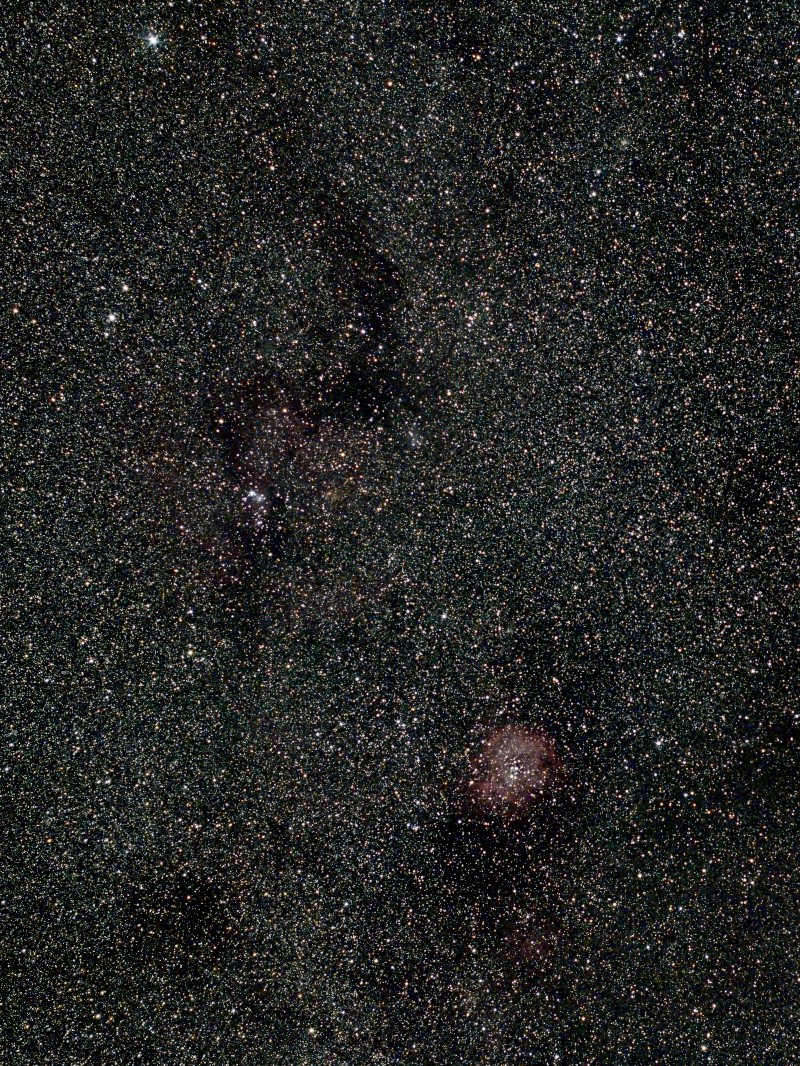
Left of center is a star cluster (NGC 2422) that looks like an upside-down Christmas
tree, and that brings me to last night's (March 14) photo session.
I moved up to my Sigma 105/2.8 DG EX lens, vintage 2005, nowadays assisted
by a black rubber band to keep its focuser from rotating under the force
of gravity or vibration, since it has loosened up a bit with age.
At f/2.8 it is as sharp as we could wish, and the tracking is good.
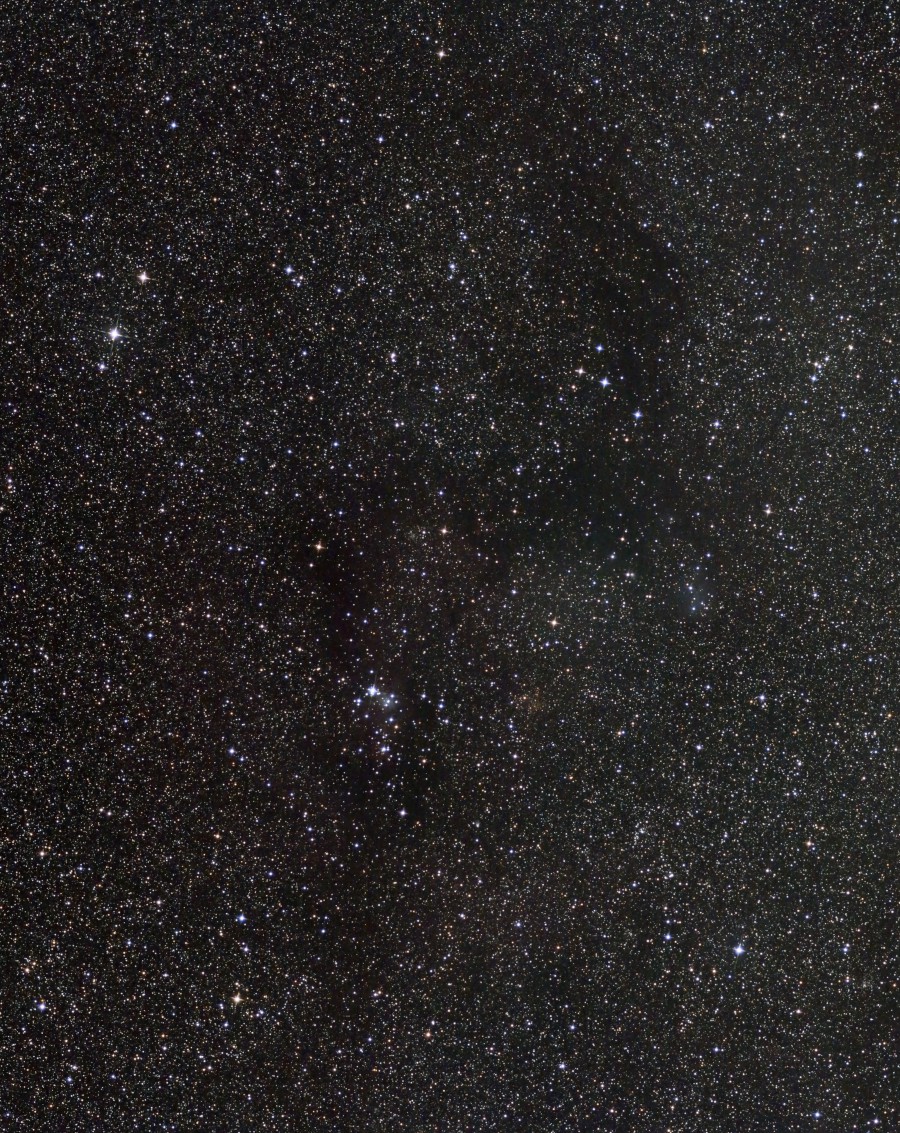
Here's the field of the Christmas Tree cluster:
|
| |
This is a stack of 40 1-minute exposures at ISO 800, f/2.8.
Again this is not the whole frame, but almost all of the left half.
Meanwhile, I had the Celestron 8 EdgeHD going on the Losmandy mount, using the f/7 reducer
and Altair 26C camera. I was using a new guidescope arrangement that wasn't as sturdy as
I hoped, so only about two thirds of the exposures were successful, but that was enough for
me to get well over a hundred for each object.
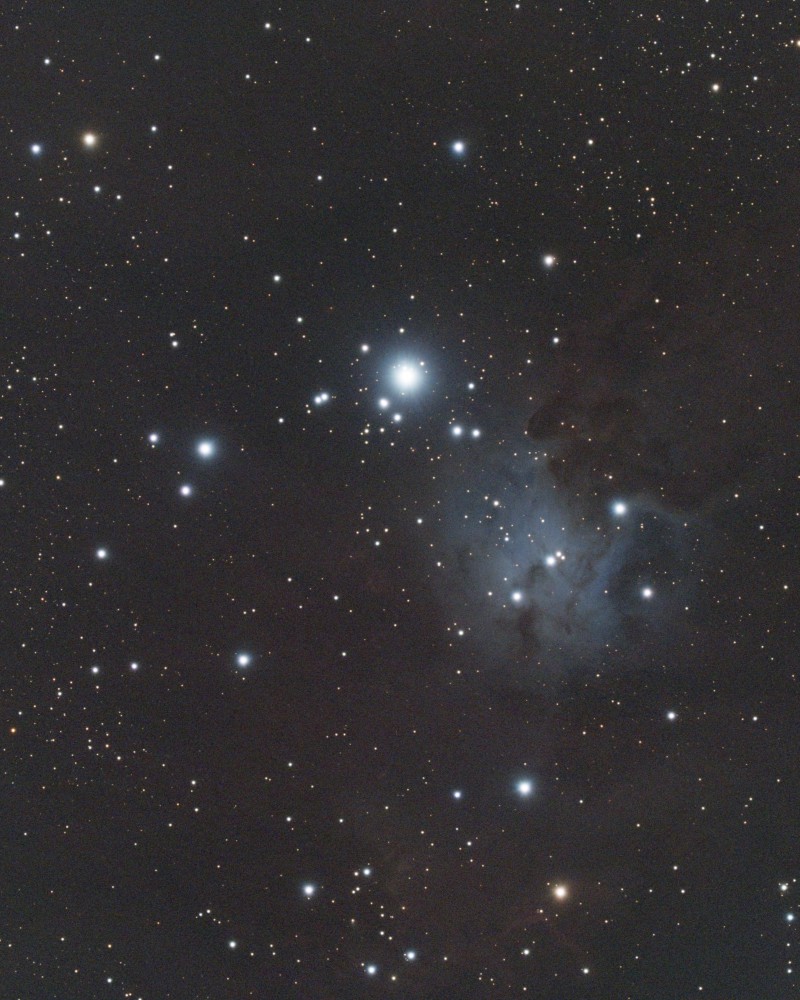
Here, then, is a stack of 120 30-second exposures of the Christmas Tree Cluster,
showing the whitish dust (reflection nebulosity) that helps fill out the tree:
Permanent link to this entry
Galaxies and an asteroid
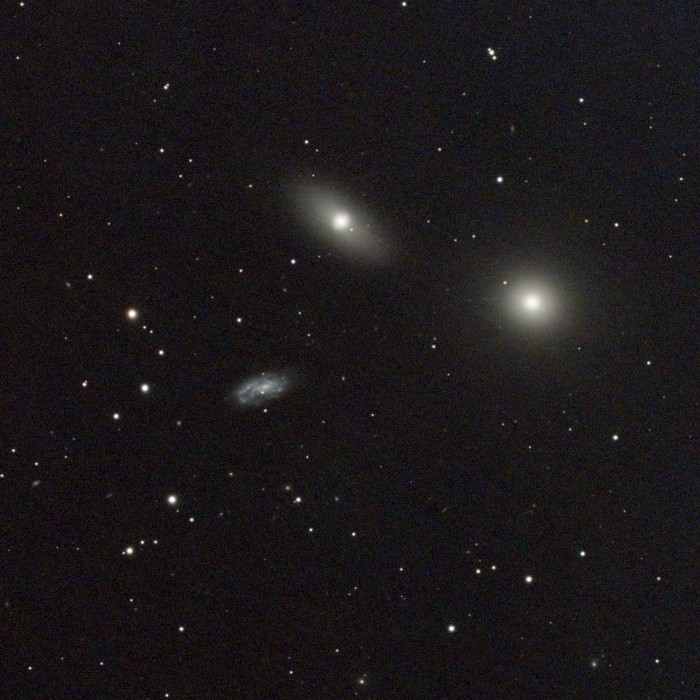
Using the same setup I took many exposures of some galaxies in Leo and stacked 120 of them.
Right to left, the bright galaxies are M105, NGC 3384, and NGC 3389. The first two are
elliptical, and the third is a flocculent (dappled-looking) spiral.
There's more. Down toward the lower left, you can see a faint galaxy near the edge of
the picture, and then an even fainter one to its right.
Those are LEDA 1210457 (magnitude 16) and LEDA 359005 (magnitude 17), two of the many
remote galaxies visible in that direction.
And there's still more. The brightest galaxy, M105, seems to have a thin streak coming
out of it to the left. That turns out to be the 17th-magnitude asteroid 1999 XR36,
which was moving in its orbit (a straight line as seen from here). Its track has a gap
in it because there was a pause in my series of exposures.
There! That was a lot of astrophotography! It starts to make up for some of the time lost
while we had bad weather, and then I had cataracts, and cataract surgery, not to mention
other things taking up my time.
Permanent link to this entry
|
2026
March
5
|
Jupiter, done properly
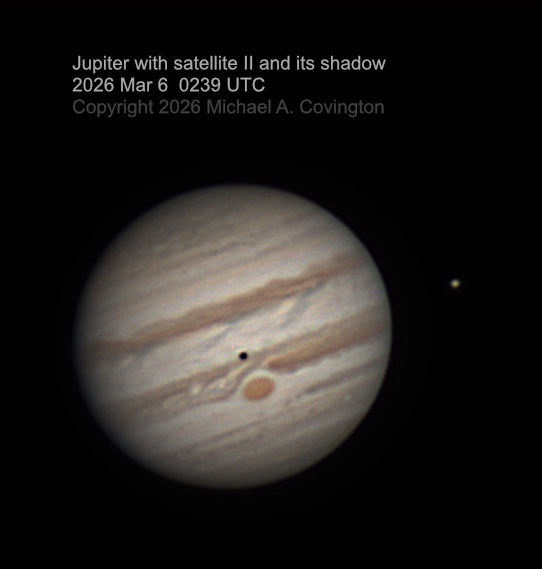
This evening (March 5) I used the 8-inch telescope to photograph Jupiter properly
(without the f/7 reducer, and with a camera with smaller pixels).
This is a stack of the best 25% of 9,105 video frames with a ToupTek 678 color camera.
I also had my first visual astronomy session, brief though it was, since both eyes fully
recovered from cataract surgery and the blurry spots that troubled me for a few weeks.
An ophthalmologist with whom I correspond about astronomy has suggested that they were
stray particles left over from removing the old lens, and adhering to the posterior
capsule or something near it, and they dissolved. We may never know, but they're gone.
I can truthfully describe the implanted lenses as better than new.
There are no unwelcome optical effects when I look through the eyepiece,
and even at 400×, which is almost too high a power for this telescope,
I get a much smoother view than even 20 years ago; the artificial lens doesn't
have the specks and spots that were always inherent in the natural one.
Permanent link to this entry
|
2026
March
4
|
Dual-booting Linux with Windows 11
On my do-everything 14-inch ThinkPad, which I take to the library and everywhere
else I do work, I needed to actually run Linux, not just WSL. So I set it up to
dual-boot. Lots of web pages tell you how to do this;
where I will mention some unobvious details.
It's not quite the same as dual-booting Windows 10 with Linux.
Most things are the same, but what has changed is that under Windows 11,
BitLocker disk encryption is more or less compulsory.
You can turn it off, but Windows updates are liable to turn it on again.
And I want to have it in place, so that if someone steals my laptop
or obtains the flash drive from it, they won't be able to read my data.
My first attempt was a disaster — Linux was happy as a clam (or penguin), GRUB worked so
that I could choose operating systems when booting, but Windows asked for the BitLocker recovery
key every time it booted. Fortunately I had my key available (I had to go home to get
it), but that wasn't acceptable. What was wrong?!
I searched online for answers and ended up completely undoing the Linux installation —
deleting the partition it was installed on, using bootsect to fix Windows
(subtle; it involved mounting the boot sector as drive S), and even hiding "ubuntu"
in the UEFI boot menu.
Well, toward the end of that process I found out what was wrong.
Windows demands the BitLocker key if Secure Boot is turned off in BIOS (UEFI).
The problem may not have been Linux at all!
But installing Linux with the wrong options can apparently cause Secure Boot to turn off,
and wiping out every last trace of Linux doesn't fix it.
So the second time, I did everything right:
- Used Disk Manager to shrink my main Windows partition, gaining a 128-MB free-space partition
into which to install Linux.
- Suspended BitLocker temporarily, knowing it would turn back on the next time Windows started up.
- Restarted and pressed F1 to get into the UEFI menu; made sure Secure Boot was turned on.
- Booted Linux Mint from a bootable USB drive and chose "Install Linux Mint."
- For the installation options I chose "Something else" and directed it to my 128-MB partition.
(It might well have found that if I had taken the default; I don't know; but that's how I've done
it in the past.)
- Also in the installation options, I made sure Secure Boot was enabled. This required
making up a password, which I stored away carefully though I don't know why I'll need it.
Linux is nowadays compatible with Secure Boot.
That gave me a successful Linux installation, with GRUB for choosing operating systems.
There were three remaining concerns.
Time zones: If Windows sets the system clock automatically (as mine does), Linux has to be told
to run on local time rather than UT (GMT), or it will reset the system clock several hours off.
Nowadays all you need is the command:
sudo timedatectl set-local-rtc 1
File sharing: Linux can't see a BitLocker-protected disk, and I think I like it that way.
(A stranger with Linux on a jump drive wouldn't be able to read my data either.)
Fortunately, my ThinkPad T490s has a strange provision for keeping a micro SD card installed
more or less permanently, though it's easy to get out, much like changing a SIM card in a phone.
I have a 256-GB card there, and both Linux and Windows can see it and write on it.
That's how I get files back and forth from one OS to the other.
I did not opt for Linux disk encryption, so I will limit the amount of confidential data
that I store in Linux. If this becomes a concern, I can presumably turn disk encryption on.
Mouse: You can't pair a Bluetooth mouse with more than one operating system;
don't try. Also, a recent-model Logitech mouse that supports both Bluetooth and USB wireless
turns out to have a complicated pairing process that I never got working as desired.
(Hint about Logitech mice: A full reset requires taking the battery out! It retains some
memory about pairing when switched off.)
What worked was to get the old, simple, plain-USB-wireless mouse (Logitech M310) from one of my other
computers. It emulates a wired mouse and has no pairing protocol.
The one spooky thing about the M310, which other Linux users have noted, is that sometimes the
mouse wheel doesn't work under Linux unless you take the battery out for a moment and put it
back in. Strange error in some Linux driver, I suppose, perhaps to be fixed in the future.
So that's how I spent a lot of time for two afternoons!
Permanent link to this entry
|
2026
March
1
|
Some astrophotography at last
Due to a remarkable spell of bad weather, I did no astrophotography at all in January, and only finally
got around to doing some on the last day of February.
My main goal was to test guiding software and a guidescope
(I'm trying out an unofficial fork of PHD2).
I had the Celestron 8 EdgeHD set up with the f/7 compressor and Altair 26C (24-megapixel) camera,
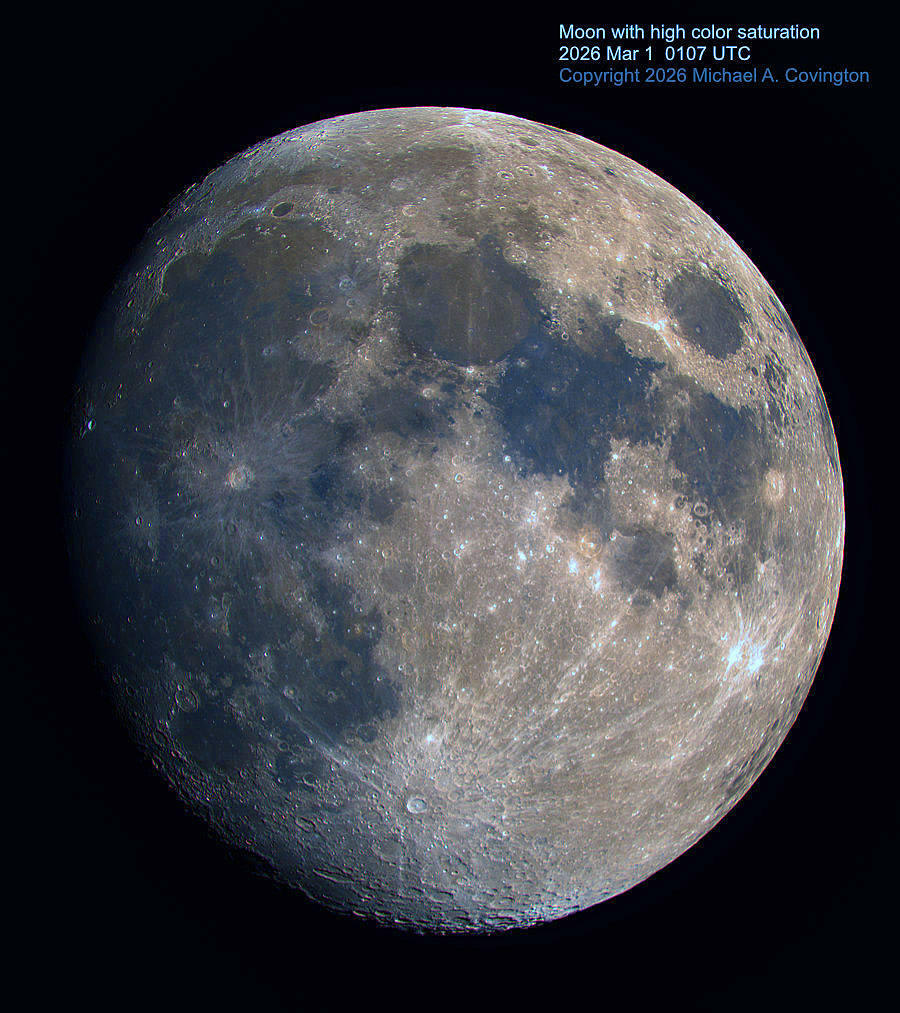
but the gibbous moon was in the sky, so the first thing I did was take a picture of the moon.
To be precise, I recorded 99 video frames, then stacked the best 75% (presumably 74 of them)
and turned up the color saturation to bring out differences in the minerals on different parts
of the moon's surface. Here's the result.
|
| |
It came out admirably sharp. I also have a higher-resolution version.
Permanent link to this entry
Moon: Aristarchus
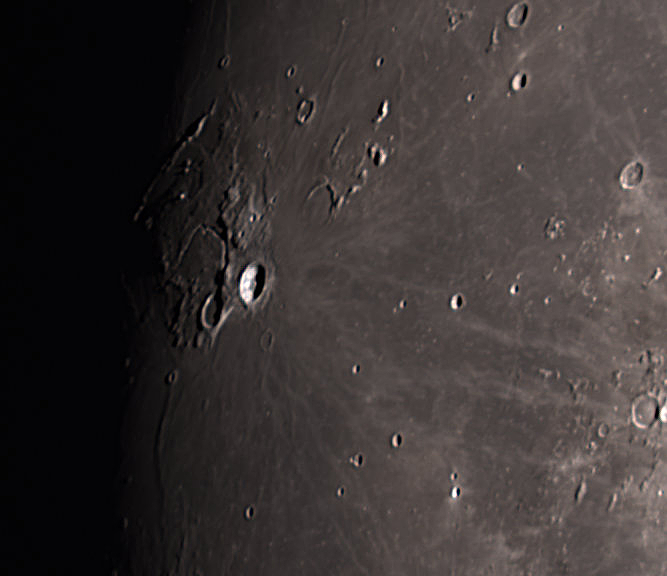
Here is the region of the lunar crater Aristarchus (a crater with a spooky reputation,
and possibly a history of outgassing, raising dust). This is taken the same way,
but not scaled down; this is full resolution. Stack of the best 50% of 2000 video frames.
Permanent link to this entry
Moon: Mare Crisium
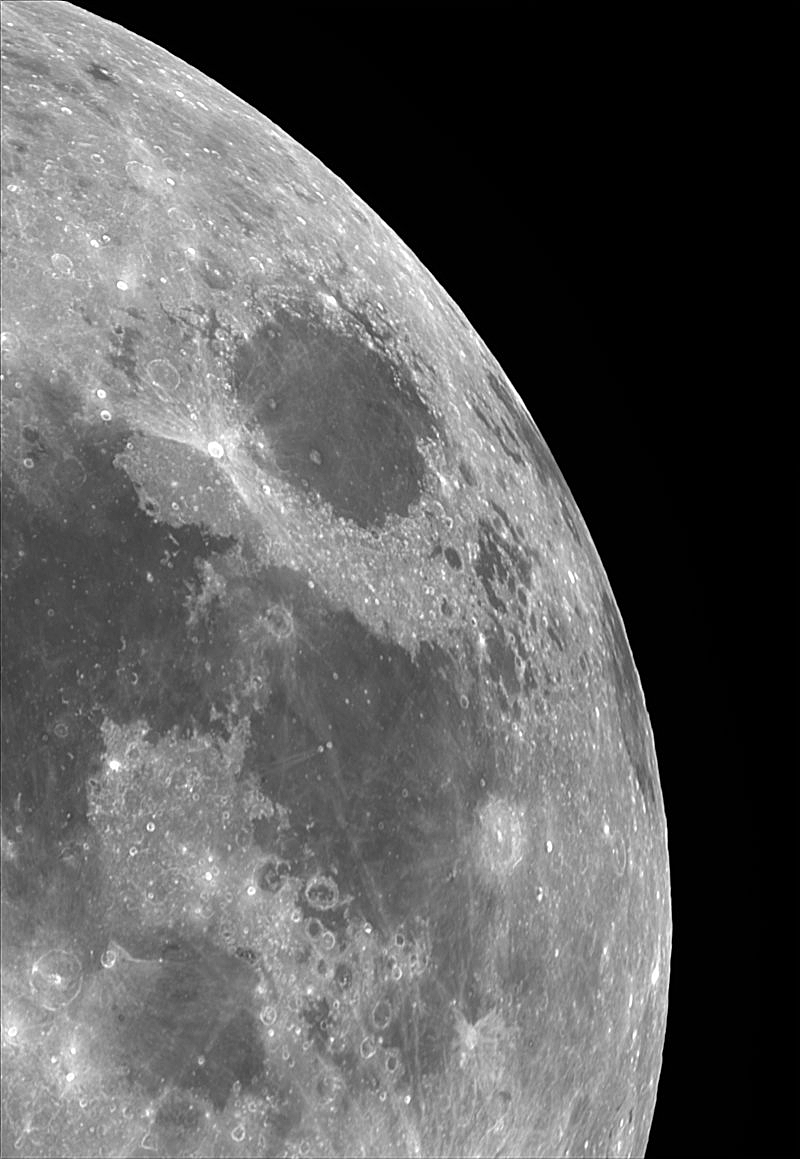
Favorable libration (an effect of non-circular orbits)
enabled me to see past Mare Crisium all the way to Mare Smythii, the dark spot right
on the edge of the visible moon. This picture is rendered in black-and-white (grayscale)
because parts of it were slightly overexposed and did not go through color correction
correctly. Stack of the best 50% of 1008 video frames.
Permanent link to this entry
Jupiter
Although definitely not using the right optical configuration or camera, I decided
to see what my f/7 deep sky setup would get when I aimed it at Jupiter.
Not nearly as much detail as when I use the planetary camera at f/10,
but definitely something.
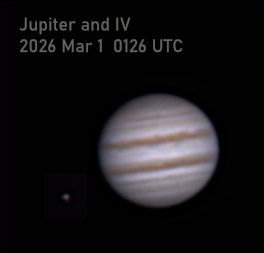
Satellite IV (Callisto) is visible; I brightened it up separately, since it is much darker
than the face of Jupiter.
By the way, I've decided to join the ranks of the astronomers
(many, since the time of Galileo) who call the first four satellites I, II, III, and IV,
as Galileo initially did, rather than Io, Europa, Ganymede, and Callisto, the names
proposed by Marius and Kepler but not widely used until the twentieth century.
If you want to know the reason, look up the mythology, and how Jupiter (Zeus)
acquired those four companions. Zeus is not an example of behavior to be emulated.
Although nobody ever talked about it, I suspect this may be why generations of
earlier astronomers were not particularly fond of that set of names.
Permanent link to this entry
M78 and NGC 2071
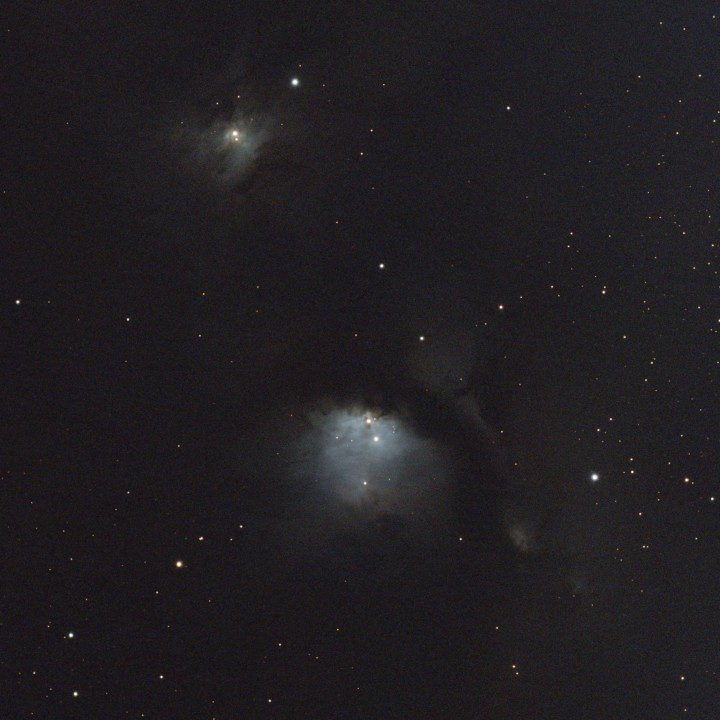
Finally, an actual deep-sky image. Because of the bright moonlight, this is not a great picture,
but it proves that the equipment worked. Stack of 150 30-second exposures. These are two
reflection nebulae, clouds of dust that reflect the light of nearby stars. M78 is the larger one.
Permanent link to this entry
|
|
|
This is a private web page,
not hosted or sponsored by the University of Georgia.
Copyright 2026 Michael A. Covington.
Caching by search engines is permitted.
To go to the latest entry every day, bookmark
https://www.covingtoninnovations.com/michael/blog/Default.asp
and if you get the previous month, tell your browser to refresh.
Portrait at top of page by Sharon Covington.
This web site has never collected personal information
and is not affected by GDPR.
Google Ads may use cookies to manage the rotation of ads,
but those cookies are not made available to Covington Innovations.
No personal information is collected or stored by Covington Innovations, and never has been.
This web site is based and served entirely in the United States.
In compliance with U.S. FTC guidelines,
I am glad to point out that unless explicitly
indicated, I do not receive substantial payments, free merchandise, or other remuneration
for reviewing or mentioning products on this web site.
Any remuneration valued at more than about $10 will always be mentioned here,
and in any case my writing about products and dealers is always truthful.
Reviewed
products are usually things I purchased for my own use, or occasionally items
lent to me briefly by manufacturers and described as such.
I am no longer an Amazon Associate, and links to Amazon
no longer pay me a commission for purchases,
even if they still have my code in them.
|
|